
A combined parasite treatment can cover several needs, but it isn’t automatically right for every dog. When choosing wormers, drenchers, flea and fly control, match the product to your pet’s weight and the parasites it targets.
It’s sensible to ask whether flea, tick and worm treatments are safe. Use a product intended for your pet and follow its directions, including the dose for their weight. Products differ in the parasites they cover, and some combine protection.
This guide covers common pet parasites, the difference between wormers and drenches, and what to consider when choosing a dog wormer. You’ll also find a comparison of treatment types and combination options, to help weigh coverage against the dosing routine that suits your dog. Parasite prevention is a year-round consideration in Australia, so knowing what each product targets can help you make an informed choice.
Key Takeaways
- Match a pet treatment to its intended species, weight and target parasites, then follow the product directions.
- Compare combined protection by the parasites covered and the dosing routine, not just the number of ingredients.
- Recognise how fleas, ticks and intestinal worms can affect pets, and why prevention needs to suit local risks.
- Explore the main livestock wormer and drench types to narrow down options for your stock and parasite-control needs.
Are flea, tick and worm treatments safe?
Safe use depends on matching the product, species and dose to the animal. Treatment intervals and protection periods vary by product.
Dosing frequency and minimum starting ages
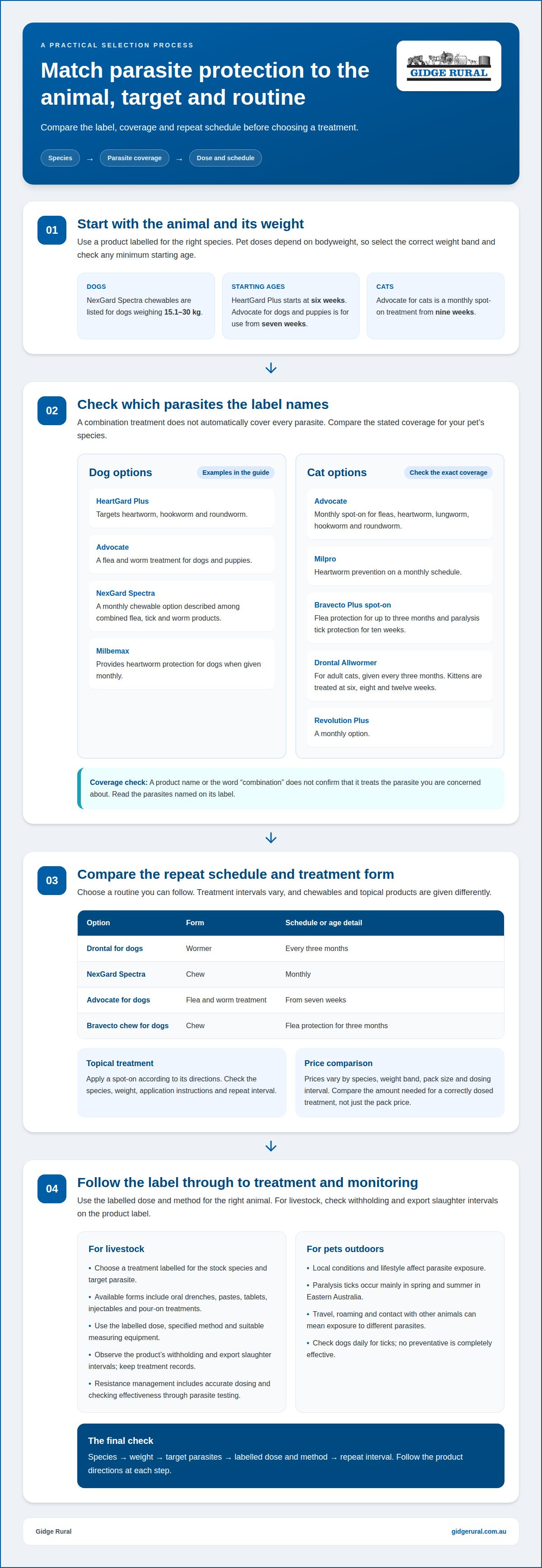
For dogs, Drontal is given every three months, while NexGard Spectra is a monthly chew. HeartGard Plus starts at six weeks and targets heartworm, hookworm and roundworm. Advocate flea and worm treatment suits dogs and puppies from seven weeks. Doses depend on bodyweight, so choose the correct weight band. NexGard Spectra chewables are listed for dogs weighing 15.1-30 kg.
Prices vary by species, weight band, pack size and dosing interval. Compare the amount needed for a correctly dosed treatment, rather than relying on the pack price alone.
| Option | Form | Interval or age detail |
|---|---|---|
| Drontal for dogs | Wormer | Every three months |
| NexGard Spectra | Chew | Monthly |
| Advocate for dogs | Flea and worm treatment | From seven weeks |
Choose by target parasites, your pet’s weight and minimum age, and a routine you can follow.
Topical flea-control administration
A topical spot-on is applied according to the product directions. Advocate is given to cats monthly as a spot-on treatment. Choose a product labelled for the right species and weight, and follow its application instructions and repeat interval. Topical and chewable treatments are administered differently, but both require the correct dose for your pet.
Livestock withholding and export intervals
For livestock parasite treatments, withholding periods and export slaughter intervals depend on the product and its label. Follow the stated interval before treating an animal intended for meat, and keep treatment records. Choose a drench for the stock type and target parasite, then administer the labelled dose using the specified method and suitable measuring equipment.
Fly control for livestock or property also depends on the target pest and where the product is intended to be used. Select a treatment whose label covers that animal or setting, and follow its application directions.
Combined heartworm, worm and flea protection
Combination treatments can simplify parasite routines, but coverage differs. Compare the label’s parasite coverage and repeat schedule before choosing.
Intestinal worm and heartworm prevention
Some treatments target heartworm as well as intestinal worms, while others cover a narrower group. Milbemax protects dogs against heartworm when given monthly; Milpro prevents heartworm in cats on the same monthly schedule. For cats, Advocate is a monthly spot-on treatment for fleas, heartworm, lungworm, hookworm and roundworm, starting at nine weeks. Drontal Allwormer for adult cats is given every three months; kittens are treated at six, eight and twelve weeks.
Combined flea, tick and worm products
For dogs, NexGard Spectra is a monthly chewable option. Advocate combines flea and worm treatment, while Bravecto products provide flea or tick protection on different schedules. These products aren’t interchangeable: check the parasites named on each label, not just whether it is a combination treatment. For cats, Bravecto Plus spot-on protects against fleas for up to three months and paralysis ticks for ten weeks. Revolution Plus is given monthly.
Use this comparison to narrow your options by species, parasite coverage and routine:
| Option | Animal | Coverage or schedule |
|---|---|---|
| Milbemax | Dogs | Heartworm protection, monthly |
| Advocate | Cats | Monthly spot-on; fleas, heartworm and intestinal worms |
| Bravecto Plus spot-on | Cats | Fleas up to three months; paralysis ticks ten weeks |
Match the product to your pet’s species, weight and target parasites, then follow its label schedule. Browse wormers, drenchers and flea and fly control options to compare product types.
Common pet parasites and their effects
Fleas and ticks can cause itching, skin irritation and infections in dogs. Intestinal parasites include roundworm, hookworm and whipworm. The right wormer depends on the parasites it targets and your pet’s weight. A product labelled for one species or parasite group may not cover another.
For sheep, cattle, goats and horses, choose a drench labelled for that species and its target parasites. Pet wormers are formulated for pets, so don’t substitute them for livestock treatments or assume one livestock product suits every animal.
Livestock drenches differ in active ingredient and the parasites named on their labels. Compare the label details with the stock species and intended use; a product name alone won’t tell you whether its coverage fits. Resistance management involves choosing an appropriate treatment, dosing accurately and assessing effectiveness through parasite testing.
For dogs, NexGard Spectra is a monthly chewable, while Bravecto chew provides flea protection for three months. For cats, Advocate and Revolution Plus are monthly options; Bravecto Plus spot-on protects against fleas for up to three months and paralysis ticks for ten weeks. Compare label coverage and how the treatment is given, rather than assuming every flea and tick product also treats intestinal worms.
Local conditions and lifestyle affect parasite exposure. Paralysis ticks occur mainly in spring and summer in Eastern Australia, while pets that travel, roam or mix with other animals may encounter different parasites. Check dogs daily for ticks, as no preventative is completely effective. A product’s listed coverage and repeat interval can guide your choice, but don’t skip checking your pet after outdoor activity.
What types of livestock wormers and drenches are available in Australia?
Livestock wormers come in several forms, including oral drenches, pastes, tablets, injectables and pour-on treatments. Sheep, cattle, goats and horses need products labelled for their species. The format tells you how to administer a treatment, not which parasites it controls.
Oral drenches, pastes and tablets are given by mouth. Injectable and pour-on products use different application methods. Before choosing a format for your stock, compare the product label’s species, target parasites and directions.
Active ingredients and parasite coverage vary between products. A drench targeting one parasite group may not cover another. Compare the named target parasites on each label instead of choosing by animal species or formulation alone.
For a practical comparison, start with the animal and purpose of treatment. Check whether the product is intended for sheep, cattle, goats or horses, then match its stated parasite coverage to the need. Follow the label’s dose and administration method. Accurate measuring helps avoid underdosing or overdosing.
Resistance management matters too. Repeatedly using the same treatment approach can reduce its effectiveness over time. Drench resistance testing can help assess how well a treatment is working on a property. Consider the results alongside product coverage and accurate dosing when planning parasite control.
Withholding periods and export slaughter intervals are specific to each product. For livestock intended for meat, follow the relevant label directions and keep treatment records. These intervals differ from pet-product schedules, so use livestock labels for sheep, cattle, goats and horses.
Compare livestock parasite-control options by species, formulation and labelled coverage before choosing a treatment.
Choose a product labelled for the animal species and target parasites. Livestock products for sheep, cattle, goats and horses should not be assumed suitable for pets.
Active ingredients and parasite coverage vary by product. Compare the target parasites named on each label and choose one that matches your control need. Formulation alone doesn’t establish which parasites a product covers.
Gidge Rural
After comparing parasite-control options and identifying what your animals need, Gidge Rural’s Animal Health & Medical Supplies range is a practical next step. The right product still depends on the animal, target parasites, product directions and dosing requirements.
For pets, distinguish intestinal worming from flea and tick control before narrowing your options. For livestock, start with the species and parasites named on the treatment label. This keeps a dog’s worming routine separate from livestock drenching decisions, where label directions and withholding periods also matter.
Use this guide’s comparison points to organise your next step: note the animal, the parasite concern, the coverage needed and the application method. This gives you a clear basis for considering relevant animal health supplies, without treating products for different species as interchangeable.
Parasite control is one part of caring for animals and managing a property. Gidge Rural also offers Premium Stockfeed, Fencing Supplies, and Reticulation & Plumbing Equipment for other day-to-day property needs. These products serve different purposes, so consider them separately when choosing a wormer, drench or flea treatment.
If you’re considering animal health supplies for your situation, contact Gidge Rural to discuss what you need.
Make your next treatment decision count
Build parasite control into a routine that suits the animals in your care. Recording the product, treatment date and animal can help keep future decisions organised. These notes also provide a useful starting point when reviewing a treatment plan or noticing a change in your animals’ needs.
For your next purchase, focus on the details that matter to your situation, not just a familiar product name. The right wormers, drenches, flea and fly control should suit the animal and intended use. Keep the product directions close at hand to make the routine clear.
Use the information in this guide to narrow down the options, then explore the available range at your own pace. Browse parasite-control options and take the next step with confidence.
Frequently Asked Questions
What safety risks, dose precautions, and environmental rules apply to wormers, drenches, and insecticides in Australia?
Use each product only for its labelled animal and purpose, and calculate the dose using the animal’s weight. A dog wormer, for example, isn’t a livestock drench. Don’t assume products can be combined or substituted. Follow the product label’s directions for application, spills and disposal. Instructions vary by formulation, so keep the label available during use.
Which wormer or drench is suitable for sheep, cattle, goats, horses, and pets?
Choose a wormer or drench labelled for the specific animal species and target parasites. Don’t substitute pet wormers for livestock treatments or assume one livestock product suits every species.
What are Australian guidelines for drench resistance testing and managing parasite resistance?
Choose an appropriate treatment, dose accurately and assess its effectiveness through parasite testing. Drench resistance testing can help show how well a treatment is working on a property.
What are current prices for wormers, drenches, flea treatments, and fly control products in Australia?
Prices vary by species, weight band, pack size and dosing interval.
What fly control products work for livestock and properties in Australia?
Choose a fly-control treatment labelled for the target pest and livestock animal or property setting, then follow its application directions.


