
Livestock farms need feeders, waterers and troughs that suit the animals they keep, the size of the group and how often supplies can be replenished. Cattle, sheep, goats, horses and poultry have different feeding and watering needs, so one setup won’t suit every property. Consider capacity, access and practical dimensions before choosing equipment.
The right choice depends on more than the container itself. Consider where animals gather and how they use it. A well-matched setup can make everyday feeding and watering more straightforward, while unsuitable capacity or placement can add work.
This guide covers which farms use feeders, waterers and troughs, how to assess capacity for different livestock, and what dimensions and product codes can tell you. It also outlines practical factors for comparing equipment and narrowing down options for your property.
Key Takeaways
- Match trough capacity to livestock numbers, drinking patterns and how often you can refill it.
- According to Bushmans, adult cattle troughs are recommended at 65 to 75 cm high, while calf troughs are recommended at 40 to 50 cm.
- Choose a feeder or trough shape that suits the animals’ access and the available space on your farm.
- Compare dimensions and product codes carefully so the equipment fits your livestock and intended setup.
Choosing trough capacity for cattle and other livestock
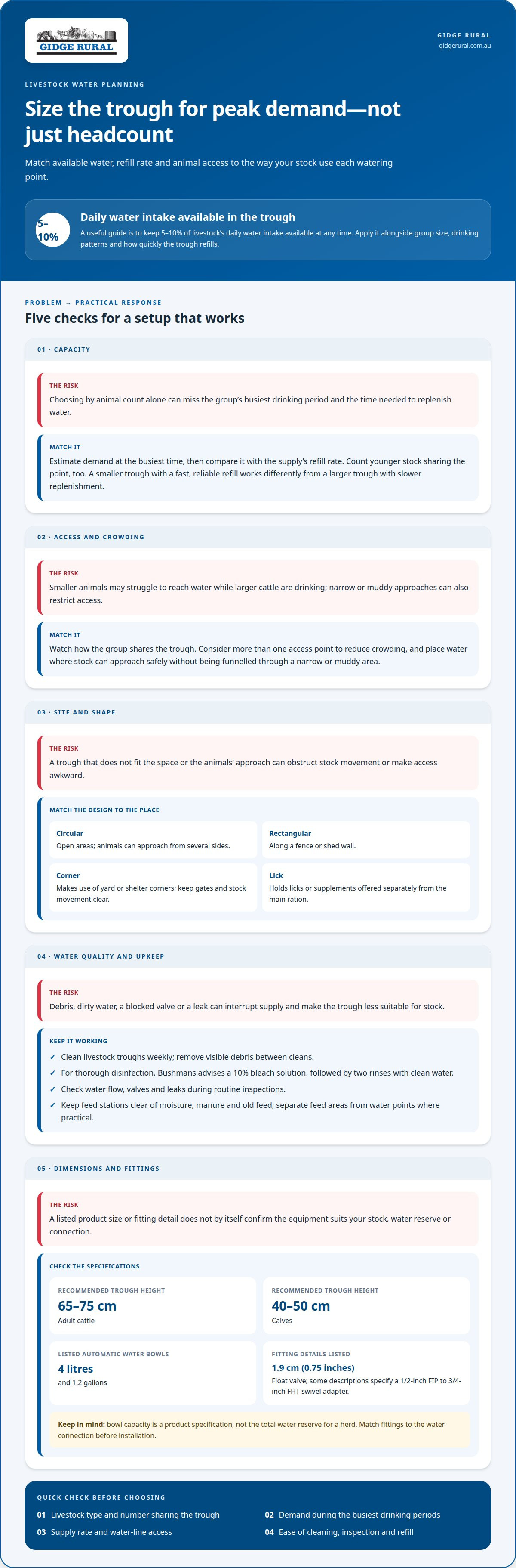
Size a trough for livestock demand, not just the number of animals. Estimate how much water the group needs during its busiest period, then consider how quickly the supply refills. A small trough with a fast, reliable refill can work differently from a larger trough with slower replenishment. Include younger stock when counting animals at each watering point.
Keep enough water available for animals to drink between refills. A useful guide is to have 5-10% of livestock’s daily water intake available in the trough at any time. For a mixed mob, consider whether smaller animals can reach the water while larger cattle are drinking. More than one access point can reduce crowding.
Australian requirements vary with the property, water source and livestock setup. Place troughs where animals can reach them safely, and consider drainage, water quality and stock movement. Avoid locations that funnel animals through narrow or muddy areas.
Connect automatic waterers to a suitable supply and position them for easy access and inspection. Clean livestock troughs weekly, remove debris and check that water flows freely. Regular checks can reveal a blocked valve or leak before the supply is interrupted.
Product capacities vary by design. For example, listed automatic livestock water bowls include a 4-litre model and a 1.2-gallon model. Treat bowl capacity as a product specification, not the total water reserve for a herd. Troughs intended for groups need capacity matched to demand and refill rate.
Before choosing, compare these practical points:
- Livestock type and the number sharing each trough.
- Water demand during the busiest drinking periods.
- Supply rate and access to the water line.
- Ease of cleaning, inspection and refill.
Check valve compatibility too. A float valve is listed at 1.9 cm (0.75 inches); some product descriptions specify a 1/2-inch FIP to 3/4-inch FHT swivel adapter. Match fittings to the water connection before installation.
Which Farmers should use Water Troughs & Feeders?
Water troughs and feeders suit farms where livestock need reliable access to water or feed. Cattle and sheep producers use them in paddocks and yards; horse properties and mixed farms can also benefit from a managed feeding area. Choose equipment to suit livestock behaviour, available space and the feed being offered.
Circular troughs suit open areas where animals can approach from several sides, which can help when a group gathers at one feeding point. Rectangular models fit along fences or shed walls, making them useful where space follows a straight boundary. Measure the site and consider how animals approach before choosing a shape.
Corner troughs use awkward spaces in yards or shelters. Check that the corner remains accessible and does not obstruct gates or stock movement. Lick troughs are designed to hold licks or supplements, making them an option when supplementary feed is provided separately from the main ration. Choose a model for its intended use, not just its footprint.
Common problems include dirty water, contaminated feed, blocked valves, leaks and restricted access. A trough that is difficult to reach or clean can disrupt routine use. Inspect equipment regularly and clear debris before it builds up.
- Cattle and sheep farms: consider how a group approaches and shares the feeding point.
- Horse properties: position equipment where horses can reach it without obstructing movement.
- Smallholdings: use corner models to make practical use of limited yard space.
- Supplement-feeding operations: consider a lick trough for a separate lick or supplement.
Before selecting a model, note the animals using it, the feed or water involved, and the available space. Then compare circular, rectangular, corner and lick designs against those needs. Explore feeders, waterers and trough options to see which style may suit your farm setup.
Farm livestock watering and feeding applications
Water points support daily routines on cattle, sheep, horse and mixed-livestock farms. Position them so animals can drink without crossing feed areas or blocking gates. Where practical, separate feed stations from water points to reduce the chance of spilled grain and hay contaminating drinking water. A dairy or beef paddock may need a different layout from a small horse yard.
Depending on the ration and livestock, feeders can hold stored fodder, grain or supplements. Choose one that lets animals reach the feed without crowding or trampling it. For example, sheep offered supplementary feed need a different access arrangement from cattle eating hay. Keep feed dry and remove spoiled material during routine checks.
Provide Australian livestock with clean, palatable water and practical access throughout the day. Keep water points reachable, maintain a steady supply and prevent feed, manure and debris from entering the trough. Choose a setup that suits the animals’ size and movement around the paddock or yard.
Water quality depends on the source, trough condition and regular upkeep. Bushmans recommends cleaning livestock troughs once a week to keep water fresh and clean. For thorough disinfection, Bushmans advises using a 10% bleach solution and rinsing twice with clean water. Remove visible debris between cleans and inspect the water supply for changes.
Use these checks to keep feeding and watering points working as intended:
- Place troughs where livestock can approach without a blocked gate or narrow passage.
- Keep feed stores and feeders clear of moisture, manure and old feed.
- Check float valves and water flow during routine paddock inspections.
- Watch how cattle, sheep or horses share access, then adjust the layout if crowding occurs.
For water planning, Bushmans advises keeping 5-10% of livestock’s daily water intake available in a trough at any time. Apply that guidance alongside the number and type of animals, their access to water, and the refill rate. These practical checks help farms organise watering and feeding around everyday stock movement.
Trough dimensions and product codes
A listed automatic water bowl measures 23 cm long and 10 cm deep. Those dimensions describe the bowl, not its capacity or how many animals it serves. Compare length and depth with the livestock’s reach, the mounting surface and the space available around the watering point. A bowl that fits physically must still allow animals to drink comfortably.
No single material or size is best for every farm. Choose materials suited to the location, cleaning routine and intended use, then match the dimensions to the animals, access and available space. A compact bowl may suit one drinking point, while a group trough needs enough room for animals to approach without crowding.
Read product codes alongside the full specifications. A code may identify dimensions, capacity, fittings or model type, but its meaning depends on the manufacturer’s format. Compare it with the listed measurements and connection details. Similar-looking codes do not necessarily describe interchangeable parts.
Measure the installation area before selecting a model. Record the available length, depth and mounting position, then compare them with the product details. Check where pipes enter and whether the water connection aligns with the unit. This can help you spot a mismatch before fitting the equipment.
Use this checklist when comparing products:
- Dimensions: compare stated length and depth with the available mounting space.
- Access: consider the animals’ reach and approach from nearby gates or fences.
- Capacity: distinguish bowl capacity from the water available across a livestock group.
- Code details: match the product identifier to measurements and fitting specifications.
For a practical comparison, keep the 23 cm by 10 cm bowl dimensions beside your site measurements. Then review feeder and trough options against the space and use requirements you’ve recorded.
Gidge Rural: Premium Stockfeed
Gidge Rural supplies products to support livestock routines, including Premium Stockfeed, Fencing Supplies, Reticulation & Plumbing Equipment, and Animal Health & Medical Supplies. Stockfeed can support feed planning alongside access to water, while fencing and reticulation supplies relate to paddock layout and farm water systems.
Turn to Gidge Rural for stockfeed and related farm supplies. Match feed choices to your livestock and existing feeding plan, and consider how paddock access and water infrastructure work together on your property.
Contact Gidge Rural to discuss your rural supply needs.
Plan the next step for your farm
Before choosing equipment, note how each livestock group uses its feeding and watering points. Record the feed type, water source, site layout and routine checks required. This gives you a practical basis for matching feeders, waterers and troughs to everyday farm use, rather than choosing by appearance alone.
Gidge Rural supplies Premium Stockfeed, Fencing Supplies and Reticulation & Plumbing Equipment for related farm needs. Consider how these products fit your existing setup as you plan improvements to livestock access and routine care.
Ready to explore options for your property? Contact Gidge Rural about farm troughs and take the next step towards a setup that suits your stock and farm routine.
Frequently Asked Questions
What types of livestock feeders, waterers and troughs are available in Australia?
Australian farms can choose feeders for hay, grain or supplements, as well as water bowls and livestock troughs. Common trough shapes include circular, rectangular and corner models; lick troughs hold supplements separately from regular feed. Automatic waterers use a float valve to maintain the water level. Choose a type to suit the feed, livestock behaviour, paddock layout and cleaning routine.
Where can I buy livestock feeders, waterers and troughs in Australia?
Browse Gidge Rural’s online shop for rural supplies to support farm routines, including Premium Stockfeed, Fencing Supplies and Reticulation & Plumbing Equipment. These products can support feed planning and farm water infrastructure. Compare equipment details with your livestock’s needs and the available installation space, then explore relevant options in the shop.
How do I choose the right trough capacity for livestock numbers and climate?
Start by counting the livestock sharing each water point, then account for hotter conditions, when animals may drink more. Check how quickly the supply refills and whether every animal can reach water during busy periods. In a large paddock, distance to the trough also affects access. Monitor use as conditions change, and adjust water provision when the group, weather or supply routine shifts.
What materials and sizes are best for farm water troughs and feeders?
Choose materials suited to the location, cleaning routine and intended use. Match dimensions and capacity to the animals, their access and available space; adult cattle troughs are recommended at 65 to 75 cm high and calf troughs at 40 to 50 cm.
Which feeders and waterers are best for cattle, sheep, goats, horses and poultry?
Choose equipment to suit livestock behaviour, group size, feed or water needs and available space. Circular troughs allow access from several sides; rectangular models suit fences or walls; corner troughs use awkward spaces; and lick troughs suit supplements. Plan access to avoid crowding.


