

You have spent a weekend sweating over a post hole digger only to hit solid granite six inches down, or watched a new wire line lose its tension as soon as the weather shifts on a steep slope. Fencing in the Perth Hills is a unique challenge that the flat coastal plains simply don't prepare you for. Between the stubborn ironstone and the constant threat of summer bushfires, your choice of fencing supplies Perth Hills landowners trust can make the difference between a lifetime asset and a constant maintenance headache.
We know you want a boundary that stays straight and stock-tight despite the rugged terrain. This guide will help you master the complexities of hilly fencing by selecting the right materials for longevity and security. We will look at heavy-duty galvanised steel options that resist corrosion, high-tensile wire for maintaining tension on gradients, and fire-proof pickets designed for our local conditions. You will learn how to build a professional-looking fence that stands its ground against the elements and the landscape.
Key Takeaways
- Learn how to manage steep gradients and rocky outcrops by using contouring techniques that maintain consistent wire tension across your property.
- Identify the specific high-tensile fencing supplies Perth Hills landowners require for maximum durability against stock pressure and local conditions.
- Master the anatomy of a strainer assembly to ensure your end-posts provide the structural strength needed for a long-lasting, professional boundary.
- Discover the essential DIY hardware, from wire strainers to petrol-powered rammers, that makes installation on rugged terrain more efficient.
- Explore how strategic internal fencing layouts can reduce stockfeed waste and improve pasture health through effective cell grazing patterns.
Planning Your Rural Fence for Hilly and Rocky Terrain
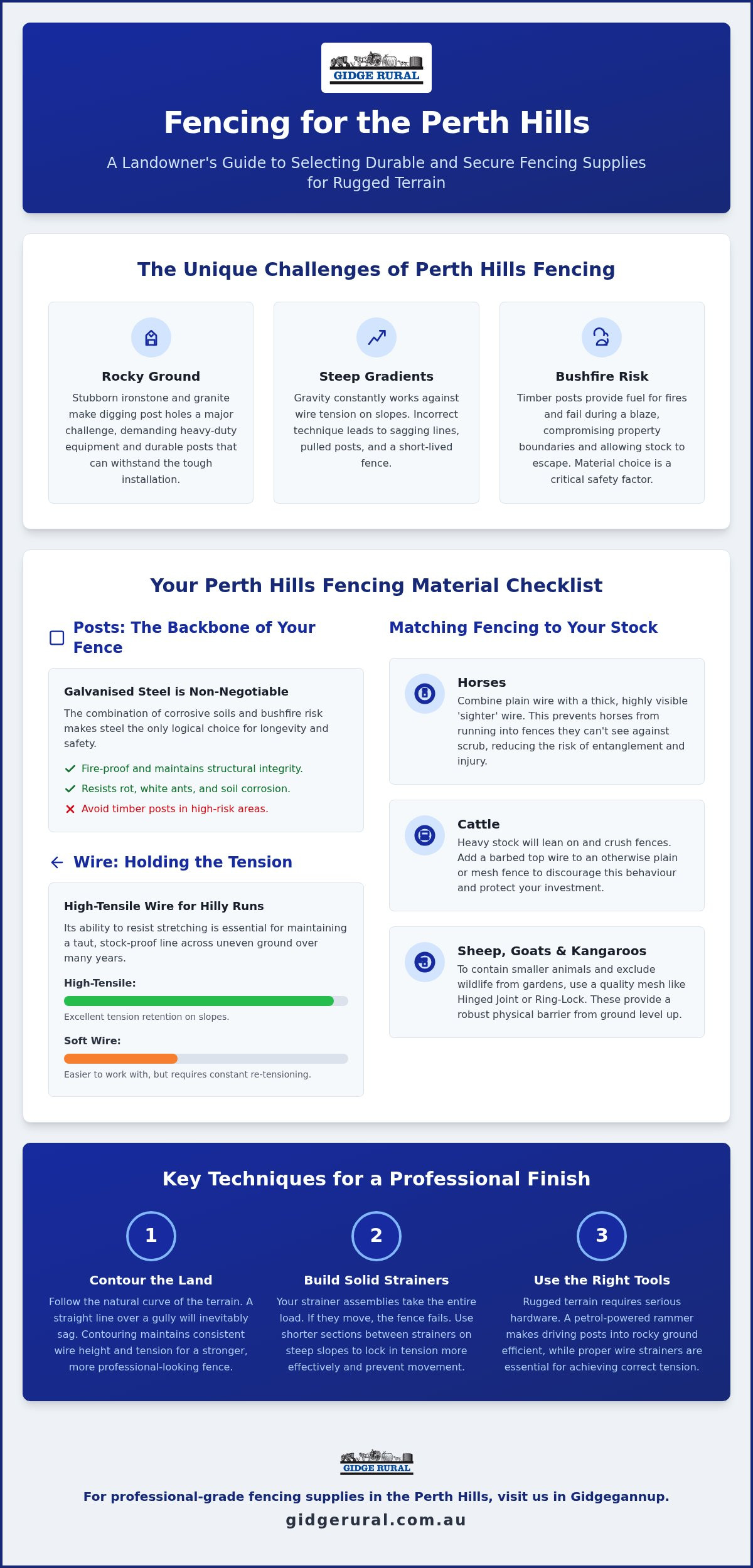
Building a fence in the Perth Hills isn't like working on a flat suburban block. You are dealing with ironstone, steep gradients, and shifting soil. When planning your boundary, you must account for how gravity affects wire tension. A straight line over a gully will result in sagging wires or pulled posts. Contouring, which involves following the natural curve of the land, is the standard approach for professional results. This method keeps the wire at a consistent height and tension, provided you use the right fencing supplies Perth Hills conditions demand.
For a broader look at how different barriers function across varied landscapes, this Agricultural fencing overview provides useful context on traditional methods. In our local area, a heavy-duty galvanised steel finish is non-negotiable. It resists the corrosive nature of our soils and stays structural long after timber has succumbed to rot or white ants. Integrating gates on these slopes requires careful placement at the highest point of a run to prevent erosion and ensure the latch remains aligned as the ground settles.
To better understand how professional materials look in a finished Perth project, watch this helpful video:
Managing Slopes and Uneven Ground
On steep inclines, standard long runs won't cut it. You need shorter sections between strainer posts to lock in tension. On downhill runs, posts require deeper footings to resist the forward lean caused by the weight of the wire. If you are building for livestock, sighter wires are critical for horse safety on hilly boundaries to prevent them from running into lines they cannot easily see against the scrub.
Bushfire Resilience and Material Choice
The Perth Hills are a high-risk zone, making material choice a matter of property security. Timber posts often fail during a fire, leaving your stock to wander and your boundaries open. All-metal systems using steel star pickets and galvanised strainers offer the best protection. They don't provide fuel for the flames and maintain their integrity even after the front passes. For more on protecting your land, see our bushfire preparation checklist for properties for broader safety planning.
Selecting the Right Fencing Materials: Wire, Posts, and Rails
Choosing the right hardware is about matching the material to the pressure of your livestock and the slope of the land. High-tensile wire is the standard for long, hilly runs because it resists stretching and stays taut over time. Soft wire is easier to tie but often requires constant re-tensioning. When sourcing fencing supplies Perth Hills locals rely on, look for heavy-duty galvanised coatings that withstand our wet winters and scorching summers. These coatings provide the necessary protection against the corrosive nature of local soil types.
The strainer assembly is the most critical part of your build. These end-posts act as the foundation and take the full load of the tensioned wire. If the strainer moves even a few millimetres, the entire fence line will sag. For the line posts, star pickets are versatile and cost-effective. Galvanised pickets are better for the rocky outcrops common in the hills as they resist scratching and rust better than black bitumen options. In high-visibility areas or internal paddocks, post and rail systems offer a professional look while providing a sturdy physical barrier.
Wire Varieties for Stock Management
Hinged joint and ring-lock mesh are excellent for containing sheep or goats and keeping hungry kangaroos out of your gardens. For horse paddocks, a combination of plain wire and a thick sighter wire prevents entanglement and injury. Cattle owners should consider a barbed top wire to stop heavy stock from leaning over and crushing the mesh. You can find a full range of these professional-grade fencing supplies at our Gidgegannup store.
Electric Fencing Essentials
Electric offsets are a smart way to protect a new investment from animals that like to rub or chew on the rails. You can choose solar-powered energisers for remote boundaries or mains-powered units for paddocks closer to the house. Earthing is the process of completing the electrical circuit through the ground, and poor installation in dry, rocky soil is the #1 cause of electric fence failure. Ensuring your earth stakes are driven into damp soil or using multiple stakes can solve most connectivity issues on rugged terrain.
The DIY Rural Fencing Checklist: Tools and Hardware
Success on a hilly block depends on your kit. You need more than just a hammer and some luck. High-quality fencing supplies Perth Hills landowners rely on include specialised tools designed to handle our notoriously rocky ground. For small repairs, a manual post driver is sufficient. If you are tackling a full boundary, a petrol-powered rammer will save your back and your weekend. Straining gear is equally vital. Wire strainers, gripples, and tension gauges allow you to achieve a professional finish that won't sag when the temperature drops. To safely transport heavy wire rolls, pickets, and gear across rugged acreage, you can find out more about Direct sales of aluminium ute trays, canopies and accessories to equip your work vehicle.
Safety is often overlooked until an accident happens. Invest in a pair of high-quality fencing pliers. They serve as a hammer, wire cutter, and stripper all in one. Sharp wire cutters are essential for high-tensile lines, as dull blades will only fray the galvanised coating. You can find all the fencing tools and hardware you need at our Gidgegannup store to get the job done right the first time.
The Step-by-Step DIY Installation Process
- Strainer posts first: These are your anchors. Set them deep and ensure they are perfectly vertical before adding tension.
- Pilot wires: Run a single strand of wire between your strainers. This acts as a visual guide for perfectly straight star picket placement.
- Secure ties: Use proper fencing knots or gripples to tie off your lines. This prevents the wire from slipping through the post holes over time.
Gate and Access Hardware
Gates are the moving parts of your fence and require the most maintenance. When sourcing fencing supplies Perth Hills residents often forget that the hardware is just as important as the gate itself. Select gate widths based on your needs, ranging from 3-foot man gates for pedestrian access to 14-foot machinery gates for tractors. Galvanised steel is the standard because it resists the elements without sagging. When installing on a slope, ensure the gate is 'swing-ready' by positioning the hinges so the gate opens uphill or has enough clearance at the lowest point of its arc. Use heavy-duty gudgeons and slam latches for a secure, easy-to-use closure.
Integrating Fencing with Total Property Management
A fence is more than a physical barrier. It is a vital tool for property efficiency. Secure boundary lines prevent costly stock "break-outs," which directly reduces stockfeed waste. When animals stay where they are supposed to, you don't just lose livestock; you lose the investment you made in their nutrition. Gidge Rural provides the fencing supplies Perth Hills owners need to turn a rugged block into a highly organised system. Using a one-stop supplier for your hardware, feed, and water needs ensures that every component of your property works together seamlessly.
Fencing and Nutrition Synergy
Effective paddock division is the secret to better pasture health. By creating smaller "cells," you can rotate livestock and prevent over-grazing. This allows the land to recover and reduces your reliance on supplementary feeding during the leaner months. You should also use internal fencing to set aside "sacrifice paddocks" during the dry season. This protects your main grazing areas from being stripped bare. Check out our guide on choosing premium stockfeed to see how a solid grazing plan and quality nutrition work hand-in-hand.
Water and Irrigation Protection
Stock can be incredibly destructive to water infrastructure. Without sturdy enclosures, cattle or horses can foul dams and damage expensive water tanks or plumbing lines. Fencing off these areas ensures a clean, reliable water supply for your animals throughout the year. If you are setting up new troughs or lines, our reticulation equipment guide offers practical advice on managing water across your acreage. Gidge Rural is your local partner for every boundary and paddock project. We stock the fencing supplies Perth Hills properties require to stay secure, productive, and fire-ready.
Secure Your Boundary with Confidence
Building a boundary in the hills is a tough job, but it's the foundation of a well-managed property. By mastering the art of contouring and selecting high-tensile wire, you ensure your stock stays secure on even the steepest gradients. Remember that galvanised steel is your best defence against the rocky ironstone and the constant threat of bushfires. These materials don't just provide security; they offer peace of mind that your hard work will last for decades.
Finding the right fencing supplies Perth Hills landowners can rely on is the first step toward a professional result. Gidge Rural is here to help as local experts in rural hardware. We specialise in Australian-grade galvanised materials and our store is open 7 days for your convenience. Whether you are replacing a few star pickets or planning a full boundary overhaul, we have the stock and the specialist knowledge to get you moving.
For those handling larger property cleanups or construction tasks, you can learn more about the skip bin hire services provided by Skip Bin Guys.
Shop our full range of rural fencing supplies at Gidge Rural
Grab your gear and get started on a fence that will stand its ground against everything the Australian landscape throws at it. We look forward to seeing you in-store soon.
Frequently Asked Questions
What is the best fencing for rocky ground where I can't dig deep holes?
Steel star pickets are the most practical choice for rocky terrain. They are designed to be driven into stubborn ground using a manual or petrol-powered driver, which avoids the need for deep holes that are nearly impossible to dig in solid ironstone. If you encounter solid rock outcrops, you might need to use shorter pickets or drill pilot holes to ensure a secure fit for your boundary.
How many star pickets do I need per metre for a standard rural fence?
You typically need one star picket every 3 to 4 metres for a standard rural boundary. When sourcing fencing supplies Perth Hills landowners often find that hilly sections require closer spacing, around every 2 metres, to prevent the wire from lifting or sagging. This extra support is vital for keeping the fence line consistent and professional across uneven ground.
Is electric fencing safe to use for horses on a hilly property?
Electric fencing is a safe and reliable way to manage horses on hilly blocks. It acts as a psychological barrier that prevents animals from leaning on or chewing the fence rails. It's essential to use a high-visibility sighter wire so the horses can see the boundary on steep gradients. Proper earthing is the key to safety; use multiple earth stakes if your soil is dry and rocky to ensure the circuit remains active.
What is the difference between high-tensile wire and soft wire for fencing?
High-tensile wire is made from high-carbon steel, which allows it to stay tight over long distances without stretching. It's the best choice for the Perth Hills because hills and gullies put constant pressure on the line. Soft wire is easier to bend and tie by hand but it lacks the structural memory of high-tensile options. This means soft wire will eventually sag and require regular, time-consuming re-tensioning.
Do I need a permit for rural fencing on my Australian property?
Regulations vary between local shires, but a permit is generally required for fences exceeding 1.5 metres in rural-residential areas. In the Shire of Mundaring, you also need a permit for electrified fences and masonry structures over 750mm in height. It is always best to check the Dividing Fences Act 1961 and your local council's specific requirements before you purchase fencing supplies Perth Hills for a major boundary project.


