
The strongest-looking spray isn’t automatically the right choice for pest control and insecticides around the home. Start by identifying the pest, where it’s active and whether a spray, gel bait or concentrate suits the job. The wrong format can miss the source of the problem or leave you with unused product.
It’s reasonable to want a practical solution without wasting product. A one-litre insecticide concentrate may provide enough for 20 to 40 average-home treatments, so measuring and mixing only what you need matters. Follow the product label for the correct dilution and application, as getting the mix wrong can affect effectiveness and safety.
This guide explains how to choose household pesticides, when gel baits may suit cockroaches, ants or silverfish, and how to handle concentrates carefully. You’ll also learn what to consider before spraying, how to avoid unnecessary applications and when a targeted approach makes more sense than treating every surface.
Key Takeaways
- Measure insecticide concentrate to the product label and mix only what the job requires to help avoid waste.
- Match gel bait to the pest you’re targeting, then follow the label for placement and use.
- Choose a household pesticide for the pest and treatment area, and consider its active ingredient before applying it.
- In an emergency involving suspected pesticide poisoning, call triple zero (000), according to the Australian Government.
What are the product wastage issues in using an insecticide concentrate?
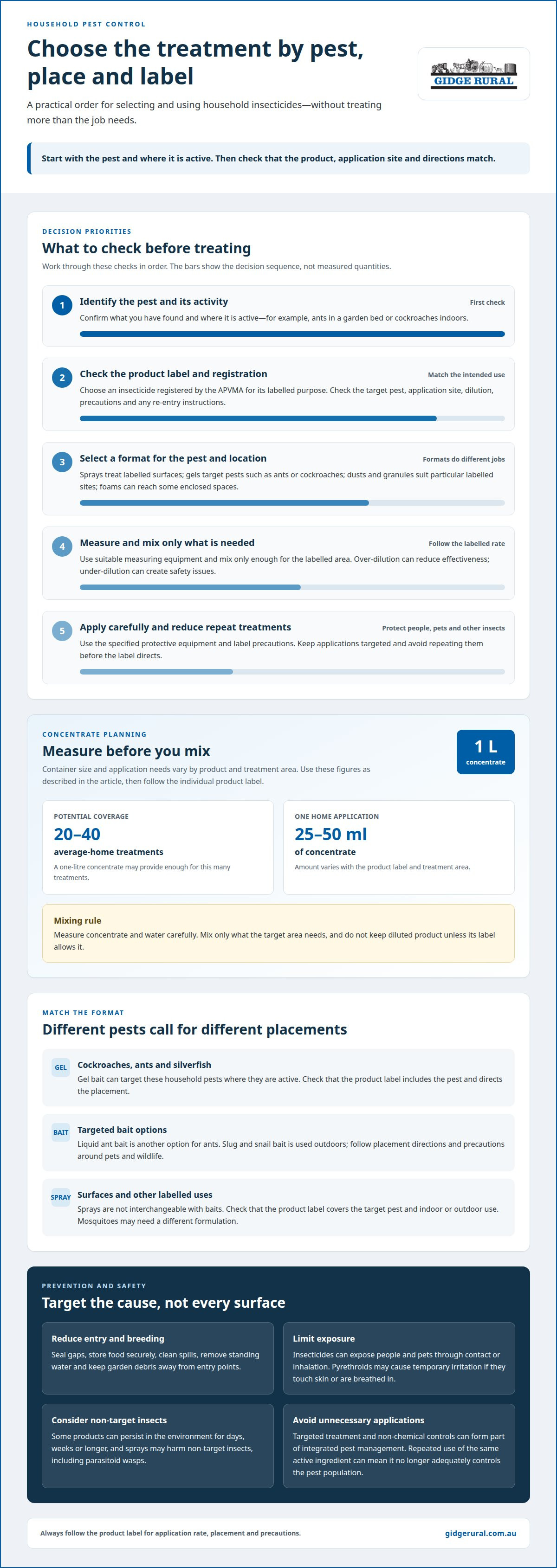
A 1 L insecticide concentrate can provide enough product for 20-40 average-home treatments. One home application may use around 25-50 ml of concentrate, depending on the product label and treatment area. Buying a large container without planning applications can leave unused product in storage.
Measure the concentrate and water carefully for each application. Over-dilution can reduce effectiveness, while under-dilution can create safety issues. Mix only as much spray as the target area needs, and don’t keep diluted product unless its label allows it. Follow the labelled rate and formulation, and use the specified protective equipment.
Choose a format suited to the pest and location: sprays treat surfaces, while dusts and granules suit particular labelled sites. Gels target pests such as ants or cockroaches, and foams can reach some enclosed spaces. Pyrethrum sprays are another option, but check that the product label covers the target pest and indoor or outdoor use.
Western Australia’s Department of Primary Industries and Regional Development publishes insecticide spray guides each year for canola, lupin and cereal crops. These guides cover crop applications, not household treatments. For any concentrate, follow its own label for the correct application rate rather than adapting a crop guide for home use.
In Australia, choose an insecticide registered by the Australian Pesticides and Veterinary Medicines Authority (APVMA) for its labelled purpose. Check the product’s APVMA registration details and label directions before use.
Insecticides can expose people and pets through contact or inhalation. Pyrethroids may cause temporary irritation if they touch skin or are breathed in. Some products can persist in the environment for days, weeks or longer, and sprays may harm non-target insects, including parasitoid wasps. Follow label precautions and keep applications targeted.
To reduce pest entry and breeding, seal gaps, store food securely, clean spills and remove standing water where mosquitoes may breed. These steps can help reduce the need for repeated applications.
Cockroach, ant and silverfish gel bait
Gel and other baits attract pests to a targeted treatment, rather than applying sprays across broad surfaces. Match the bait to the pest and placement, and follow its product label.
Gel bait for household pests
Gel bait can target cockroaches, ants and silverfish in locations where these pests are active. Goliath Plus Gel Bait contains 0.4 g/kg fipronil and 0.4 g/kg chlorfenapyr, and comes as four 30 g units. Follow its label for placement and use, keeping bait away from children, pets and food surfaces. Check whether the product’s labelled target includes the pest you’ve found.
Other bait formats
Liquid ant bait offers an alternative to gel: Maxforce Quantum Liquid Ant Bait contains 0.3 g/L imidacloprid and comes in three 30 g units. Baits are designed to attract their target, so place them where the label directs. Slug and snail bait is used outdoors, where placement and precautions matter around pets and wildlife. Poisoned bait can control a target pest, but a lasting result depends on using the right product and following its directions.
Common household pests
Cockroaches, ants and silverfish are common household targets for gel bait; mosquitoes may need a different formulation. Identify the pest before choosing a product. For example, bait labelled for ants isn’t automatically suitable for cockroaches. Pyrethrum sprays are another format, but they aren’t interchangeable with baits. Match the product to the pest and location, including indoor or outdoor use, and follow the label to avoid unnecessary applications.
For a closer look at available household bait and insecticide options, compare each product’s target pest and directions before choosing.
Pack sizes can help when comparing formats: Maxforce Quantum Liquid Ant Bait is sold in a pack of 3 x 30g, while Goliath Plus Gel Bait is sold in a pack of 4 x 30g. Compare each format with its label directions before choosing.
Choosing and using household pesticides
Begin by identifying the pest and where it is active, such as ants in a garden bed or cockroaches indoors. Insecticides are pesticides designed to control or repel insects. Choose a product whose registered use and formulation match the target. A surface spray, bait and concentrate have different application methods, so the label determines where each belongs.
In Western Australia, pesticides may only legally be used for a purpose shown on the approved product label. The Australian Pesticides and Veterinary Medicines Authority registers pesticides for use in Western Australia. Before buying, check the label for the target pest, application site, dilution, precautions and any stated re-entry instructions. Use the listed concentration: changing it can reduce performance or create safety issues.
Measure concentrate with suitable equipment and mix only the volume needed for the labelled area. Household insecticides have a shelf life of two years; performance cannot be guaranteed for products older than two years. Some surface sprays and termite treatments can persist in the environment for days, weeks or longer, so avoid repeat applications before the label directs.
Build prevention into your action plan. Seal entry gaps, remove food scraps and standing water, and keep garden debris away from entry points. These steps address access and breeding sites instead of relying on residual pesticide alone. Pest control can form part of integrated pest management, combining targeted treatment with non-chemical controls. Repeated use of the same active ingredient can mean it no longer adequately controls the pest population.
Pyrethroid insecticides can cause temporary irritation if they contact skin or are breathed in. Wear appropriate safety equipment and follow label precautions, particularly during indoor application. If pesticide poisoning is suspected in an emergency, call triple zero (000), according to the Australian Government.
Choosing an insecticide for general pest control
The right method depends on the pest, its location and the scale of the problem. Match the active ingredient and application to the target, rather than relying on broad product claims.
Pest control methods by pest
For ants and cockroaches, choose a labelled bait or spray suited to their activity. Termites need a termite-labelled treatment, such as bait or foam, rather than a general surface spray. Rodent baits target rodents, but place them to protect children, pets and wildlife. For mosquitoes, remove standing water; mosquito larvae can also be controlled with Bacillus thuringiensis ssp. israelensis in local water sources.
DIY products and licensed services
DIY products can suit targeted jobs when you’ve identified the pest and the label covers the intended site. A licensed operator can assess a larger infestation, difficult access or recurring activity, then select and apply a treatment. Termites, for example, may need a more specific approach than ants in a kitchen. Both DIY and professional methods depend on correct pest identification and product use.
Australian pesticide rules include national registration and state or territory requirements. The Australian Pesticides and Veterinary Medicines Authority registers pesticides for use in Western Australia; there, insecticides may only be used for a purpose shown on the approved label. In Victoria, the Department of Health issues photo ID licences to pest control operators, and a licence can list up to three authorisations.
Consider a licensed operator when termites, recurring pests or a widespread infestation need assessment, or when treatment involves difficult-to-reach areas. The pest, extent of the infestation, access and treatment method all affect professional pest control costs. Compare the scope of work rather than relying on a single price.
For product details, explore household insecticide options and match the label to your target pest.
Gidge Rural
Gidge Rural can support the wider property work that helps keep outdoor areas tidy and practical. Once you’ve identified a pest and chosen a suitable treatment, consider whether fencing, water systems or garden materials also need attention. These property needs can sit alongside a broader plan to reduce pest access and breeding spots.
For example, Fencing Supplies can help with property boundary projects, while Reticulation & Plumbing Equipment supports water-system needs. Garden & Landscaping Materials are useful when maintaining outdoor spaces. Gidge Rural also offers Animal Health & Medical Supplies for animal health needs. These products complement household pest planning, but they are not pesticide treatments.
Contact Gidge Rural to discuss the supplies that suit your property needs.
Make your next property-care decision
Use your observations to shape a practical property-care plan. Consider where pest activity starts, what may be attracting pests, and whether changes to storage, water systems or outdoor areas could help. A practical plan for pest control & insecticides should reflect the conditions around your home, not rely on a one-size-fits-all treatment.
Gidge Rural also offers Premium Stockfeed, Fencing Supplies and Reticulation & Plumbing Equipment for other property needs. Treat pest control & insecticides as one part of wider property upkeep, alongside supplies suited to your rural property.
For product advice, contact Gidge Rural and take the next step with confidence.
Frequently Asked Questions
DIY Pest Control - Which insecticide should you choose?
Choose a product labelled for the pest and place you need to treat. For example, a product intended for outdoor perimeter use may not be suitable inside a kitchen. Identify the pest first, then compare the label’s target pests, application sites and active ingredient. If the infestation is widespread or keeps returning, a licensed pest control operator can assess the problem and treatment options.
What formulation type should you use?
Choose a formulation that suits the pest’s behaviour and where it appears. Gel bait can be placed in targeted spots, while liquid ant bait is designed for ants to find and feed on. Sprays treat labelled surfaces, and dusts, granules or foams suit only the sites listed on their labels. Don’t choose by format alone: check the target pest and directions.
What type of insecticide should you use?
Use an insecticide with an active ingredient labelled for your target pest and treatment site. Bifenthrin and esfenvalerate are pyrethroids found in some hardware products for long-lasting control. Insecticide applications can also affect beneficial insects, including parasitoid wasps. For repeat treatments, consider whether a different insecticide group is appropriate, and follow the product label rather than increasing the dose.
What are the steps for safely using insecticides at home?
First, read the label and confirm the product suits the pest and site. Remove food and utensils from the treatment area, and keep children and pets away as directed. Wear the protective equipment listed, measure and apply the product exactly as instructed, then observe any re-entry directions. Store it securely after use. In an emergency involving suspected pesticide poisoning, call triple zero (000), according to the Australian Government.
What insecticides are registered for use in Australia and how can I check their APVMA approval?
Choose an insecticide registered by the APVMA for its labelled purpose. Check the product’s APVMA registration details and label directions before use, including the target pest and application site.


