

The biggest pump isn’t always the right one. A pump that moves water quickly may still be a poor fit if its flow rate, pressure control or switch setup doesn’t suit the job. Choosing pumps & accessories starts with what water you need to move and where it needs to go.
Whether you’re dewatering a low-lying area or transferring water around a rural property, matching the pump to the task helps avoid an unsuitable setup. The controls and fittings matter too, especially when deciding between a tank or tankless switch kit.
This guide explains how to assess pump flow rates and capacities, what pressure switches and controllers do, and how tank and tankless kits differ. It also covers the factors that shape a practical choice for dewatering and water transfer, helping you narrow down equipment to suit your system and day-to-day needs.
Key Takeaways
- Match a pump’s flow rate to the volume and distance involved, rather than choosing on power alone.
- Choose pressure controls that suit the pump and the system’s operating needs.
- Separate dewatering needs from water transfer tasks to narrow down the right pump type.
- Consider whether a switch kit with a tank or a tankless setup better fits how the system will run.
Pump flow rates and capacities
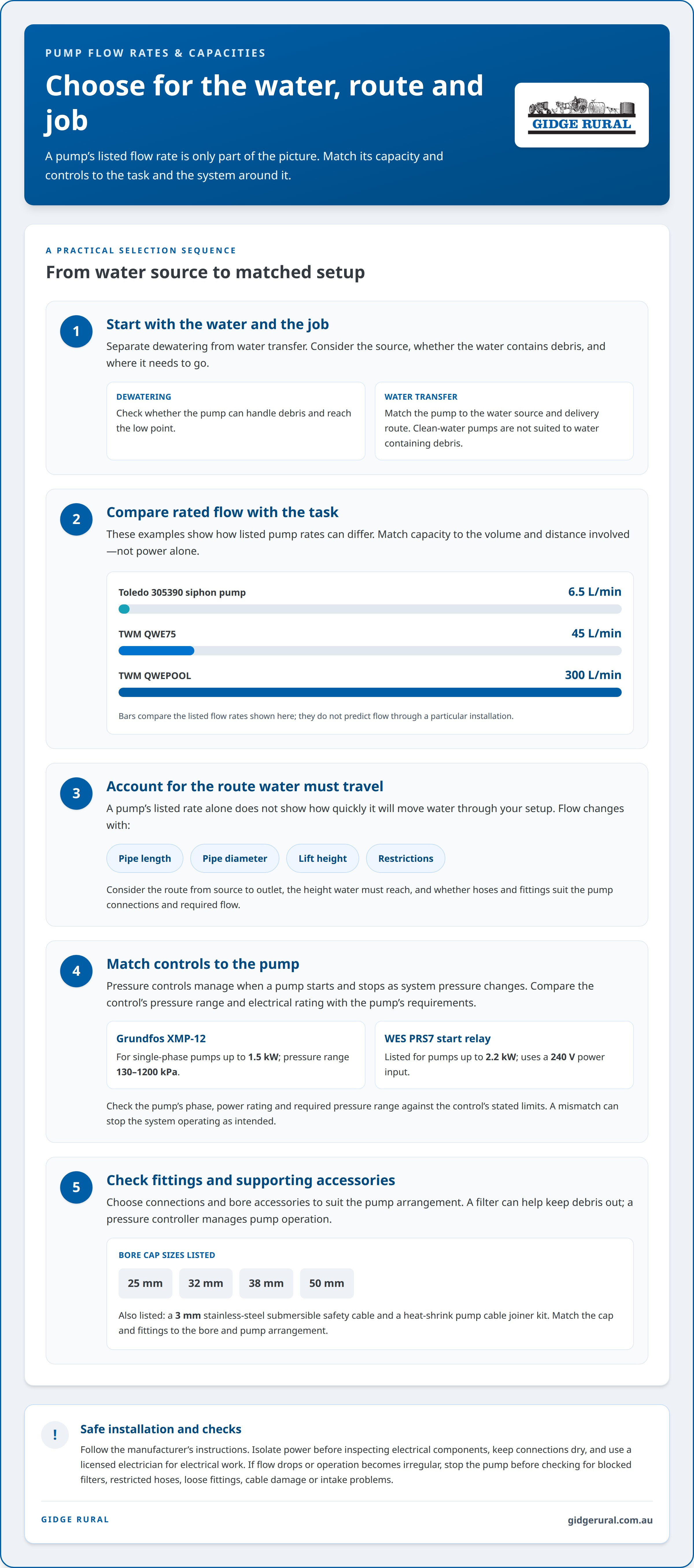
Selecting pumps & accessories starts with the water volume and destination. The TWM QWE75 is rated at 45 litres per minute, while the TWM QWEPOOL is rated at 300 litres per minute. A Toledo 305390 siphon pump moves 6.5 litres per minute. These examples suit different transfer rates. Match capacity to the task, not just the pump’s power.
Flow changes with pipe length, diameter, lift and restrictions. A pump’s listed rate alone won’t show how quickly it will move water through your setup. Consider the route from source to outlet and the height the water must reach. Hoses and fittings should suit the pump connections and required flow. The right pumps & accessories must work as one system. A pressure controller manages operation, while a filter can help keep debris out.
Bore pump accessories support suspension, connection and maintenance. A stainless-steel submersible safety cable has a listed 3 mm size. Bore caps are available in 25 mm, 32 mm, 38 mm and 50 mm sizes. Match the cap and fittings to the bore and pump arrangement. A heat-shrink pump cable joiner kit is another cable-joining option.
For pump start relays, match the relay’s electrical rating to the pump. The WES PRS7 is listed for pumps up to 2.2 kW and uses a 240 V power input. Compare those limits with the pump’s requirements before choosing a relay.
Australian standards and regulations depend on the pump’s electrical setup, water use and installation location. Electrical, plumbing and local water authority requirements may apply to different parts of a project.
For safe installation and maintenance, follow the pump manufacturer’s instructions. Isolate power before inspecting electrical components, keep connections dry, and use a licensed electrician for electrical work.
If flow drops or the pump runs irregularly, check for blocked filters, restricted hoses, loose fittings or cable damage. Stop the pump before clearing a blockage, then inspect its intake and water supply. Operating it with damaged wiring can create an electrical hazard or damage equipment.
Pump pressure switches and controls
Controls manage when a pump starts and stops as system pressure changes. Compare the controller’s pressure range and electrical rating with the pump’s requirements.
Automatic Pump Control
An automatic pump control responds to system demand, reducing the need for manual switching. The TWM QWEPU10 is an automatic pump control. For selection, match the control type to the pump and the way water is drawn. A pressure switch kit may suit a system with a set operating range. Check the pump’s electrical details and the control’s stated limits before choosing a unit.
AC Pump Controllers
AC controllers are designed for alternating-current pump setups. The White International controller is rated at 240 V and has an adjustable setting, automatic restart and a 3-pin plug. Single-phase AC pump controllers are available in DYA-S06 and DYA-S03 models. Match the controller model and electrical rating to the pump, then consider whether its control arrangement suits the system’s demands.
Pressure ranges matter. The Grundfos XMP-12 pressure switch suits single-phase pumps up to 1.5 kW, with a range of 130-1200 kPa. Those specifications help narrow compatibility, but don’t assume every switch suits every pump. The BAUMER 1.25-inch pressure switch kit is rated at 10 Bar. Compare units and pressure ranges with the pump and plumbing system.
Controllers have different specifications. The Bianco iCON NXT, NXT PRO and iCON NXTPRO PLUS are pressure-controller options. When comparing models, focus on the pump’s phase, power rating and required pressure range. A mismatch can prevent the system from operating as intended. Let the pump’s duty and the controller’s listed limits guide your choice.
For a matched setup, browse pump controls and accessories alongside the pump specifications. Compare labels before selecting components, especially where a system combines a pressure switch with an automatic controller.
Water pumps for de-watering and water transfer
Choose a pump for its water source and intended job: removing unwanted water differs from moving clean water between tanks. Pump type, solids handling and outlet arrangement all affect suitability.
Clean-Water Jet Pumps
For transferring clean water, a jet pump can suit a setup drawing from a tank or other water source. Match its capacity to demand and the delivery route, including lift and pipe restrictions. Keep the intake clear, and use hoses and fittings suited to the pump connections. A clean-water pump isn’t suitable for water containing debris.
Submersible describes a pump’s position in the water; centrifugal describes how it moves water. Transfer pumps are selected to move water between locations, while pressure pumps serve systems that need pressurised delivery. In specialised water treatment and dosing setups, pulsafeeder metering pumps are often utilised when exact volume control is required. These categories can overlap, so choose according to the water, installation position and required delivery.
Pump Types and Differences
For dewatering, consider whether the pump can handle debris in the water and whether its intake can reach the low point. A submersible unit may suit a flooded area, while a surface-mounted transfer pump needs an appropriate intake arrangement. Match the pump to the source and discharge route rather than relying on a category name alone.
Water-level sensors and float switches help control operation based on water level. The Water Level Sensor for Solar Pumps is one example; a water-tank submersible pump float switch has a 10 m lead. The Floating Type Level Switch for AC and Solar DC Pumps has a rated current of 10A. Match the switch to the pump system and intended function.
Aquarium water pumps serve a different setting from rural de-watering. Choose one for the aquarium’s circulation needs, not for transferring water around a property. For fire-water transfer, a fire-water hose kit such as the Total Rubber RUBFREHOSE provides the hose component; pump and hose connections must suit the setup. Water-level indicators, including the Apex Visi Ball 2M, help monitor tank levels. Consider the water source, pump type, control and discharge equipment together before assembling the system.
Pressure switch kits with and without tanks
A pressure switch starts or stops a pump as system pressure changes. The right kit depends on the pump, water demand and whether the setup includes a pressure tank. Solar DC pumps have tankless low-pressure and high-pressure kit options. Match the kit size and pressure type to the system.
A tankless kit controls the pump without a pressure tank in the setup. It can suit systems designed around direct pump operation and a compatible switch. The low-pressure switch kit for solar DC pumps without a tank is available for 1.25-2-inch sizes. Check the pump connection and operating requirements before selecting the kit.
High-pressure tankless kits are also available for solar DC pumps. The listed 1.5-inch kit differs from the 2-inch option. Choose the size that matches the pump and pipework, rather than relying on the pump’s outlet diameter alone. Connection compatibility and the required pressure range both affect selection.
A tank kit includes a pressure tank alongside the switch arrangement. The tank stores pressurised water, helping meet short draws without requiring the pump to start for each one. Tank size and switch settings need to suit the pump and expected use. A poor match can cause frequent cycling or inconsistent delivery.
Compare the system in sequence: identify whether it uses solar DC or another pump type, confirm the connection size, then assess whether a tank forms part of the setup. The listed tankless solar DC options cover low-pressure kits from 1.25-2 inches and high-pressure kits in 1.5-inch and 2-inch sizes. Those dimensions describe specific kit options, not a universal fit.
Before choosing, compare the pump’s pressure and electrical requirements with the switch kit specifications. A pressure switch controls operation; it doesn’t replace correct pump sizing or suitable pipework. If the system already has a tank, select components intended for that arrangement. For tankless solar DC setups, browse pressure switch kits and pump accessories to find options by kit type and size.
Gidge Rural
Gidge Rural is a practical next step when you’re narrowing down equipment for a rural water system. Its Reticulation & Plumbing Equipment offering supports the fittings and water-system needs that sit alongside pump selection. Bring your intended use into focus: whether you’re transferring water, managing pressure or planning a tank setup. Those details help identify which components fit the job and how they work together.
For other property needs, Gidge Rural also stocks Premium Stockfeed, Fencing Supplies and Animal Health & Medical Supplies. Keep the pump’s purpose and system requirements in mind when choosing related supplies, so each purchase suits the work at hand.
Contact Gidge Rural to discuss your rural water-system requirements.
Plan your next water-system step
Before choosing pumps & accessories, map out how water moves across your property and where the system needs to deliver it. A clear picture of the job helps focus your decisions on compatible equipment and supporting supplies, rather than parts that don’t suit the setup.
Gidge Rural stocks Reticulation & Plumbing Equipment for water-system needs, along with Premium Stockfeed and Fencing Supplies for other practical property requirements. Keep each purchase tied to its intended job, and have your pump and system details ready when seeking advice.
For help with your next step, contact Gidge Rural for pump advice. A well-matched setup starts with a clear purpose, and you’re ready to move forward.
Frequently Asked Questions
What types of pumps and accessories are available in Australia?
Australian rural water systems can use submersible, surface-mounted, transfer, pressure and siphon pumps. Supporting equipment includes suction and delivery hoses, foot valves, check valves, float switches, pressure controllers, cable joiners and tank-level indicators. Each accessory has a distinct role: hoses carry water, valves manage its path, and switches or controllers help operate the pump. Choose components that suit the water source and system connections.
How do I choose the right pump for my application?
Start by identifying what the water contains and where it needs to go. Transferring clean water between storage points has different demands from removing water containing debris. Then consider the power supply, pump location, pipe route and how the system will be controlled. For example, a remote tank may call for a different setup from a pump serving regular water draws at a property.
How do I size a pump based on flow rate, head and pressure?
Estimate the flow your task needs, then account for the height the water must rise and resistance through pipes, bends and fittings. Head describes the work needed to move water through that route; pressure is the force available at delivery. Use the pump’s performance chart to find its flow at the required head, rather than relying only on its maximum flow figure. Check that result against the outlet demand.
What are the best water pump brands and models in Australia?
Choose a model by matching its flow rate, pressure, pump type and operating requirements to the job. Examples include the TWM QWE75 and QWEPOOL water pumps, and the Toledo 305390 siphon pump.
How much do pumps and pump accessories cost in Australia?
Prices vary by pump type, capacity and accessories. Check current Australian retailer listings for pricing.
Where can I buy pumps and accessories in Australia, and what warranties are offered?
Gidge Rural is presented as a place to explore rural reticulation and plumbing equipment.


