

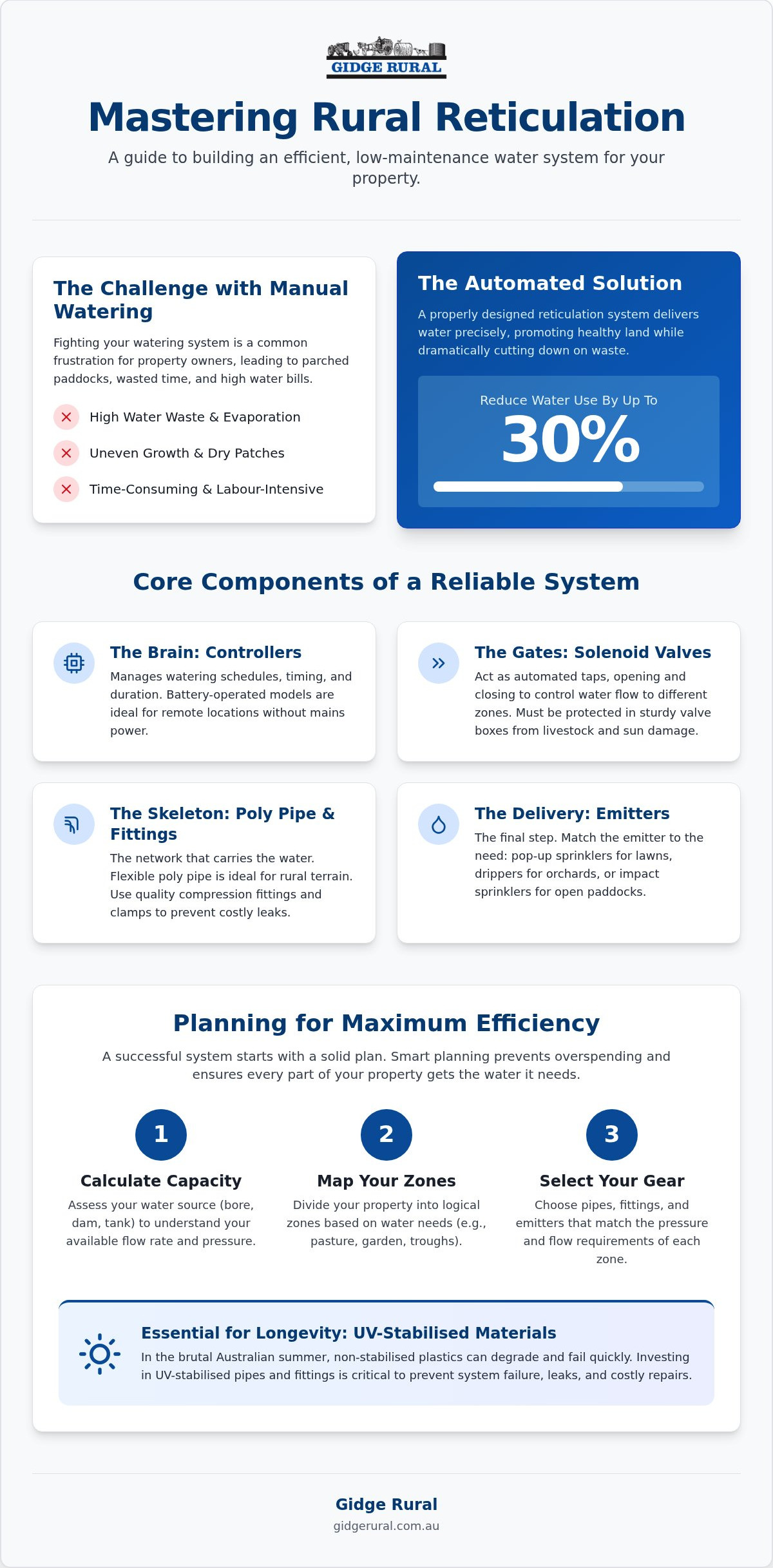
What if the reason your paddocks are looking parched isn't a lack of water, but a simple mismatch in your poly pipe fittings? Managing a rural property is hard enough without fighting your watering system every weekend. You've likely felt the frustration of low water pressure or the headache of trying to match different reticulation equipment components that just won't play fair. It's a common struggle, but getting your setup right can actually reduce your water use by up to 30 percent while keeping your land healthy and productive.
This guide helps you select and organise the right gear to ensure efficient water management across your entire property. We'll walk through the essential components, from durable pumps to smart controllers that take the guesswork out of scheduling. You'll learn how to build a system that runs automatically with minimal maintenance. This ensures healthy pastures and gardens without the sky-high water bills often caused by inefficient, leaking setups. Whether you're managing a small hobby farm or a large station, the right hardware makes all the difference.
Key Takeaways
- Understand the vital differences between standard backyard setups and the heavy-duty systems required for rural paddocks and livestock.
- Identify the core reticulation equipment components, such as solenoid valves and controllers, that form the backbone of a reliable water network.
- Learn how to calculate your water source capacity and map out zones to maximise efficiency across your entire property.
- Discover why investing in UV-stabilised materials is essential for preventing system failure during a brutal Australian summer.
- Gain the knowledge to create an automated, low-maintenance system that keeps your land healthy while keeping water costs down.
What is Reticulation Equipment and Why Does Your Property Need It?
At its core, reticulation is the organised distribution of water through a network of pipes, valves, and emitters. For the rural property owner, this setup is far more complex than a simple backyard sprinkler kit. Reticulation equipment is the hardware required to move water from a source to its final destination efficiently. While a suburban garden might rely on mains pressure and soft garden hoses, a rural property demands heavy-duty components that can handle varied water sources like bores, dams, or tanks. Investing in professional-grade gear ensures your water distribution system stands up to the harsh Australian climate.
The Role of Reticulation in Rural Water Management
Effective water management is the lifeblood of any productive property. It maintains pasture health for livestock and keeps dust levels down around the homestead. A robust system also plays a critical role in bushfire preparation by ensuring perimeter areas stay hydrated during the peak of summer. By connecting your water tanks and bores to a structured network, you ensure that every garden bed and water trough receives a reliable supply without constant manual intervention. High-quality reticulation equipment ensures these connections remain leak-free and functional even in remote areas of your land.
While ensuring your land stays hydrated is vital, protecting yourself from the sun while enjoying your homestead is just as important; you can check out Pergola2Go for high-quality aluminium pergolas designed for the Australian outdoors.
Reticulation vs. Manual Watering
Hand-watering is simply not practical for large Australian properties. It's a time-consuming chore that often leads to uneven growth and significant water waste through evaporation. Automation changes the game. A well-planned system uses precise drippers and sprinklers to deliver water exactly where it's needed, even during extreme heatwaves. This precision ensures plant survival while reducing water waste, which is vital when you're relying on limited tank storage or bore quotas. Moving from a standard garden hose to an automated system provides the consistency your land needs to thrive.
Core Components: Building a Reliable Reticulation System
A high-performing system relies on every part working together. If one component fails, the whole network can collapse, leading to dry patches or wasted water. Choosing the right reticulation equipment involves more than just picking parts off a shelf; it requires matching hardware to your property's specific pressure and flow requirements. Every piece of gear, from the smallest fitting to the main controller, must be durable enough to handle the rigours of rural life.
The Nervous System: Controllers and Solenoids
Controllers act as the brain of your setup. They manage the timing and duration of every watering cycle. For remote property locations without easy access to power, battery-operated controllers are a reliable solution. These units sit inside valve boxes and trigger the solenoid valves, which are the gates that open and close to control water flow. Protecting these solenoids is vital. Sturdy valve boxes prevent damage from heavy livestock or the degrading effects of the sun. Without these gates functioning correctly, you lose the ability to zone your property effectively.
For those looking to expand automation beyond the paddock, Asthome Smart Electrical Supplies provides specialised components and guides on how smart technology can support independent living and property management.
The Skeleton: Poly Pipe and Fittings
Piping and fittings form the backbone of any rural network. High-pressure PVC is often used for main lines, but poly pipe is the preferred choice for most rural applications due to its flexibility. You'll generally choose between low-density poly for lateral garden lines and high-density poly for high-pressure main lines. Using quality plumbing supplies like compression fittings and stainless steel clamps is the best way to prevent leaks. These connections must withstand the constant expansion and contraction caused by the Australian climate.
The final step is selecting emitters to deliver the water. Choosing between pop-up sprinklers for homestead lawns and precision drippers for orchards is a key part of modern water conservation practices. Micro-sprays are excellent for delicate nurseries, while impact sprinklers are better suited for large, open paddocks. By matching the emitter to the specific area, you ensure every drop is used efficiently without unnecessary runoff. This level of detail keeps your reticulation equipment running at peak performance year after year.
Maximising Efficiency: Planning Your Water Distribution
A successful setup starts long before you dig a single trench. Planning is the most critical stage of selecting your reticulation equipment. Without a clear map of your property's water needs, you risk overspending on gear that doesn't fit your capacity. Efficient planning is essential for managing agricultural water use, especially when every litre counts during a dry spell. Start by determining your water source capacity. You need to know the flow rate and pressure available at the source to ensure your system doesn't starve for water halfway through a cycle.
Solving Pressure Problems on Large Acreage
Large properties often face the challenge of friction loss over long pipe runs. If your sprinklers aren't throwing as far as they should, you might need a booster pump to maintain adequate pressure. Elevation changes also play a massive role. Water moving uphill loses pressure, while water moving downhill gains it. Using pressure-compensated drippers is a smart way to ensure consistent flow regardless of the slope. These specialised emitters keep the output even, preventing pooling at the bottom of a hill and parched soil at the top.
Zoning for Success
Never mix lawn sprinklers and garden drippers on the same solenoid valve. Lawns and garden beds have vastly different requirements for both timing and pressure. Grouping plants with similar needs into specific zones allows for much better control. Calculate the total litres per minute (LPM) for every emitter in a zone. If the total LPM exceeds your source capacity, the zone won't function correctly. Proper zoning ensures your system remains balanced and efficient. For the best results, source your reticulation and plumbing gear from a specialist who understands rural scale requirements.
Finally, match your emitters to your soil type. Heavy clay soils absorb water slowly, so low-flow drippers are ideal to prevent runoff. Sandy soils drain quickly, meaning you may need more frequent, shorter watering bursts. Accounting for these variables during the planning phase prevents common failures and ensures your system lasts for decades.
Selecting High-Quality Gear for Longevity and Performance
Cutting corners on hardware is a recipe for disaster on a rural property. Cheap components often fail after a single Australian summer, leading to expensive repairs and lost vegetation. Investing in professional-grade reticulation equipment ensures your system survives the harshest seasons. UV-stabilised materials are non-negotiable for any exposed piping or emitters. Without this protection, plastic becomes brittle and cracks under the intense sun. This principle applies to all property infrastructure; for example, high-end sun protection solutions like markiser sjælland are designed specifically to provide long-lasting durability against UV degradation. Choosing industrial-strength gear now prevents the frustration of mid-season breakdowns.
Maintenance Tips for a Trouble-Free System
Regular upkeep prevents small issues from becoming total system failures. If you're using bore or dam water, cleaning your filters is a priority. Silt and organic matter can quickly clog fine nozzles and damage solenoid diaphragms. It's a simple task that saves your pump from unnecessary strain. Walk your lines before the peak of summer to check for leaks or blocked emitters. A quick inspection often reveals damage from livestock or pests that could otherwise waste thousands of litres of water. Keeping a small kit of spare joiners and clamps on hand makes these quick fixes effortless.
Why Gidge Rural is Your Retic Partner
We understand the unique demands of Australian land because we live it too. Our team provides a comprehensive range of retic, plumbing, and premium stockfeed to keep every aspect of your property running smoothly. We focus on stocking hardware that is built for the long haul in local conditions. Expert advice is available in our storefront seven days a week. This ensures you get the right gear the first time, whether you're upgrading an old line or starting a new project. We act as a partner in your property management, offering reliable solutions that work.
Take Control of Your Property's Water Future
Building a reliable water network is one of the most important investments you'll make for your land. By matching your reticulation equipment to your property's specific flow rates and elevation, you ensure every drop is used effectively. Moving from manual watering to an automated, zoned system saves time and protects your pastures during the most brutal heatwaves. Choosing UV-stabilised, professional-grade hardware isn't just about convenience; it's about building a system that lasts for decades rather than just one season.
At Gidge Rural, we're here to help you get the job done right. Our comprehensive range includes everything from water tanks and pumps to the smallest plumbing fittings. We offer national shipping for all irrigation supplies, and our expert rural specialists are available seven days a week to provide practical advice tailored to your land.
Browse our full range of reticulation and plumbing equipment today and start building a more efficient, resilient property. With the right gear and a solid plan, you can enjoy healthy gardens and productive paddocks year-round.
Frequently Asked Questions
How do I know what size poly pipe to use for my reticulation?
Pipe size is determined by your water source's flow rate and the distance the water needs to travel. Most lateral lines for garden beds use 19mm poly pipe, while main lines on rural properties typically require 25mm or 32mm to maintain pressure over long runs. Using a pipe that is too small causes friction loss, which starves your sprinklers of the pressure they need to function correctly.
Can I run my reticulation system off a water tank?
You can certainly run your system from a water tank, but you will need a dedicated pressure pump to move the water effectively. Gravity alone rarely provides the force required to trigger solenoid valves or operate pop-up sprinklers. It is vital to ensure your pump is sized to match the total flow requirements of your largest watering zone to prevent the system from pulsing or failing.
What is the best type of sprinkler for a large rural lawn?
Gear-driven rotor sprinklers are usually the best choice for large rural lawns due to their long throw and even coverage. They are more efficient than standard fixed sprays because they deliver water in a rotating stream, which reduces wind drift and evaporation. For very large, open paddocks, heavy-duty impact sprinklers are a sturdy alternative that can handle water from dams or bores without clogging easily.
Do I need a plumber to install my reticulation equipment?
You must use a licensed plumber for any connection to a potable mains water supply to comply with the AS/NZS3500.1 plumbing code. However, most owners can install the downstream reticulation equipment themselves, including laying pipes and setting up controllers. If you are drawing from a private bore or dam, the requirements are generally more flexible, though professional advice helps ensure a leak-free setup.
How do I protect my reticulation system from frost in winter?
Protecting your reticulation equipment from frost involves burying your main lines at least 300mm deep where the soil acts as natural insulation. For any exposed components like pumps or backflow preventers, use high-quality foam insulation or a dedicated pump cover to prevent the water inside from freezing and cracking the housing. In regions prone to heavy frost, installing a manual drain valve at the lowest point of the system allows you to empty the lines before winter hits.


