

Rural bushfire defence isn't won when the smoke appears on the horizon. It's won months earlier through infrastructure resilience and water security. If you've been searching for a practical bushfire preparation checklist for properties, you probably know that generic government pamphlets often leave you with more questions than answers. It's stressful worrying whether your firefighting pump will start or if your livestock have a safe place to go when every second counts. We understand that protecting a rural acreage requires a specific, no-nonsense approach to maintenance and equipment.
This 2026 guide gives you a clear path to follow so you can protect your home, assets, and animals with confidence. With the AFAC autumn 2026 outlook identifying heightened risks across New South Wales, Victoria, and Western Australia, preparation is more critical than ever. We'll preview the essential tasks for hardening your home, securing your reticulation, and ensuring you have the 10,000 litres of dedicated water storage recommended by fire authorities. You'll finish with a prioritised plan that keeps your property and your livestock safe during the heat of the season.
Key Takeaways
- Align your physical property preparation with your choice to stay and defend or leave early to ensure your setup matches your plan.
- Identify critical maintenance tasks for your Asset Protection Zone and learn why sealing 2mm gaps is vital against ember attacks.
- Audit your water security using our bushfire preparation checklist for properties to ensure you have a reliable Static Water Supply independent of mains power.
- Create a safe refuge for livestock by using strategic internal fencing supplies to manage fuel loads and maintain water access.
- Learn the safest way to store stockfeed and hay to prevent these essential supplies from becoming fire hazards near your home.
Developing Your Bushfire Survival Plan: The First Step
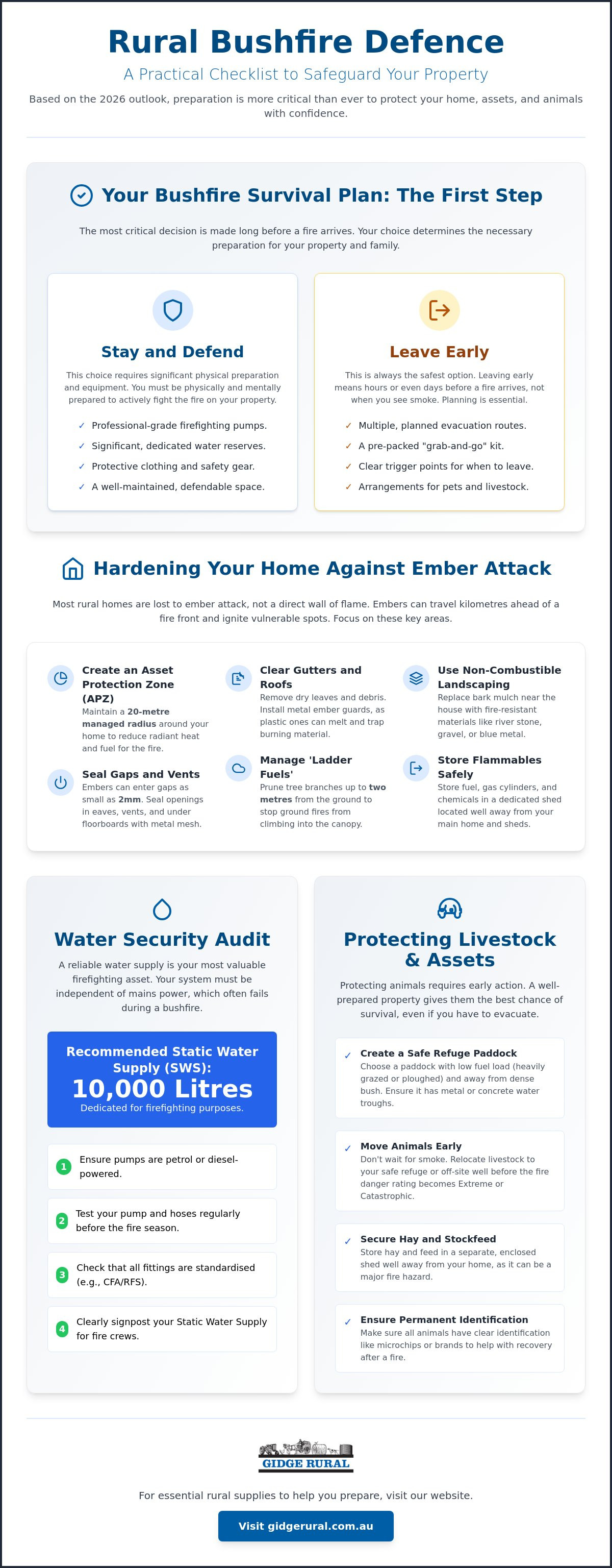
Your survival plan is the foundation of any bushfire preparation checklist for properties. The most critical decision you'll make is whether you will leave early or stay and defend. This isn't a choice to make when the sky turns orange. If you plan to defend, your property needs professional-grade pumps and significant water reserves. If you plan to leave, you must go hours or even days before a fire reaches your gate. For a comprehensive overview of wildfires and how they impact rural landscapes, understanding fire behaviour is essential for making this call.
To better understand how to structure your planning, watch this helpful video:
Evacuation planning for rural owners is more complex than for suburban residents. You need to identify multiple routes that can accommodate large trailers or livestock floats. Don't rely on a single exit; fallen trees or emergency vehicles often block primary roads. Pack a grab-and-go kit containing woollen blankets, protective clothing, and essential documents for your family and pets. Set up a communication tree with your neighbours to track local activity. While apps provide data, a quick call from the person three paddocks over can give you the head start you need to move animals safely.
Defining Your Trigger Points
The Australian Fire Danger Rating System (AFDRS) provides the framework for your actions. A trigger point is the non-negotiable moment action is taken. Your triggers should be based on the fire danger rating, local wind speeds, or a specific distance from a reported fire. When the rating hits "Extreme" or "Catastrophic," leaving the night before is often the only safe option.
Pet and Animal Preparedness
Move horses and livestock to a safe zone or off-site location well before smoke is visible. Loading a stressed horse into a float during a fire is dangerous and often impossible. Ensure all animals have permanent identification, like microchips or brands. Using reliable equestrian equipment from Feral Pony can help manage your animals more effectively during these high-stress situations. Keep your animal health supplies in a portable, waterproof container so you can grab them quickly. A well-stocked kit allows you to treat minor injuries or smoke inhalation immediately after you reach safety.
Creating a Defendable Space and Hardening Your Home
Hardening your home is a physical extension of your Bushfire Survival Plan. It starts with the Asset Protection Zone (APZ). This is a 20-metre managed radius around your homestead designed to reduce radiant heat and ember contact. Most rural homes aren't lost to a direct wall of flame but to ember attack. Wind-borne embers can travel kilometres ahead of a fire front, finding gaps as small as 2mm in vents, eaves, or under floorboards. Sealing these entry points is a non-negotiable item on any bushfire preparation checklist for properties.
Avoid using bark mulch or organic materials near your walls. These act as tinder during a fire event. Choose non-combustible garden and landscaping materials like river stone, gravel, or blue metal instead. These create a fire-resistant barrier that won't ignite from falling sparks. Keep gutters clear of dry leaves and install metal ember guards. Plastic guards often melt under heat, which can trap burning debris directly against your roofline.
Vegetation Management in Paddocks
Maintain your property's perimeter by slashing long grass and maintaining clear firebreaks. Focus on ladder fuel management by pruning tree branches up to two metres from the ground. This stops ground fires from climbing into the tree canopy. You can also use specific fertilisers to keep lawns and buffer zones green and hydrated. Healthy, moisture-rich vegetation is far less likely to ignite than dry, nutrient-depleted grass.
Hardening Buildings and Sheds
Don't overlook your outbuildings. Fit metal fly wire to all windows and ventilators to block sparks. Timber fencing can often act as a fuse that leads a fire directly to your house or shed. Consider replacing high-risk sections with metal alternatives to break the path of the flame. Store all flammable liquids, fuel, and gas cylinders in a dedicated shed located well away from your primary residence and livestock areas. For those establishing similar infrastructure in other regions, Zim MegaStore provides a reliable source for bulk building materials and farm inputs to support rural resilience.
Essential Firefighting Equipment and Water Security
When a bushfire approaches, you cannot rely on mains water or grid electricity. Pumps fail when the power cuts, and mains pressure often drops to a trickle as everyone in the district turns on their hoses at once. A reliable bushfire preparation checklist for properties must prioritise a dedicated Static Water Supply (SWS). This means having a water tank, dam, or pool that is accessible even when the town supply fails. Most Australian fire authorities recommend a minimum of 10,000 litres of dedicated water storage, though 20,000 to 30,000 litres is safer for larger rural holdings.
Your choice of pump is just as critical. Diesel pumps are generally more reliable in high-heat conditions because diesel has a higher flash point than petrol, which can suffer from vapour lock in extreme temperatures. Ensure your pump is self-priming so it works immediately without manual priming. To keep your system in top shape for the season, explore our range of reticulation and plumbing equipment designed for rugged rural conditions.
The Firefighting Hardware Checklist
- Step 1: Inspect your firefighting pump monthly. Run it for at least 15 minutes to ensure the seals stay lubricated and the fuel hasn't gone stale.
- Step 2: Check all hoses for UV degradation. Sun-damaged hoses can burst under pressure. Ensure your nozzles adjust from a wide spray for ember control to a high-pressure jet for spot fires.
- Step 3: Store enough fuel in a safe, cool, and accessible location away from the pump itself to ensure you can refuel safely during an event.
Water Tank Maintenance
Inspect poly and steel tanks for structural weaknesses or leaks that might have developed over the winter months. Your tank is only useful if the fire brigade can connect to it. Ensure your tank valves are fitted with standard 65mm Storz or Camlock fittings, as these are the universal connections used by fire services across Australia. Clearly signpost your water supply with an 'SWS' marker so crews can find it quickly in low visibility.
Protecting Livestock and Rural Assets
Protecting your animals is often the most emotional part of a fire event. A proper bushfire preparation checklist for properties must include a dedicated plan for livestock welfare. This begins with identifying a "safe paddock" or "sacrifice area" well before the season starts. This space should be a large, central area with minimal fuel loads, achieved through heavy grazing or ploughing. Ensure the water source for this paddock is gravity-fed or powered by a diesel pump, as solar and electric systems often fail during a fire.
Your choice of materials matters. Synthetic fencing like electric tape or plastic-coated wire can melt and entangle panicked stock. Use plain wire and robust fencing supplies to secure your refuge zones. Stockfeed management is another critical factor. Store haystacks at least 50 metres away from the homestead and livestock. Hay is highly flammable and burns for days, creating a persistent radiant heat hazard. Keep a 48-hour reserve of premium stockfeed in a protected location. You'll need this immediately after the fire passes when pastures are scorched and transport routes are closed.
Fire-Resistant Fencing Strategies
Replace timber fence posts with steel star pickets in high-risk perimeter areas. Timber posts often smoulder and fail, allowing livestock to wander onto roads or into burnt ground. Clear all vegetation and debris along your fence lines. This prevents "wicking," where a fire follows a line of dry grass or timber directly across your property. A clean fence line is a simple but effective firebreak.
Securing Farm Machinery
Park tractors, headers, and utes in a cleared area or inside a non-combustible shed. Machinery is a significant investment and can be an ignition source itself. Before the fire season begins, clean all engines and headers. Remove bird nests, dust, and dry chaff from engine bays. These small pockets of debris can ignite quickly when machinery is moved in high-heat conditions.
Secure Your Future Before the First Spark
Effective property defence is built on early action and reliable infrastructure. You've learned how to harden your homestead against ember attacks and why a dedicated, independent water supply is non-negotiable. By establishing safe paddocks and fire-resistant fencing now, you ensure your livestock have the best chance of survival when conditions deteriorate. These practical steps form the backbone of a resilient rural lifestyle.
Completing a bushfire preparation checklist for properties is a significant task, but you don't have to do it alone. As a locally owned rural specialist, Gidge Rural is here to help you get the job done right. We stock leading brands of firefighting equipment and offer expert advice on water tanks and reticulation systems to suit your specific acreage. We understand the unique challenges of Australian land ownership and provide the sturdy, no-nonsense solutions you need.
Browse our range of firefighting pumps and rural supplies at Gidge Rural to ensure your property is fully equipped. Take the time to prepare today so you can face the fire season with confidence and peace of mind.
Frequently Asked Questions
What is the most important item in a bushfire preparation checklist?
The most important item is a written and practiced Bushfire Survival Plan. While physical gear is vital, knowing exactly when to leave or stay determines your safety. This plan should be the first entry on any bushfire preparation checklist for properties. It ensures you don't waste time making life-or-death decisions while under the pressure of an active fire front or heavy smoke.
How much water do I need to defend a rural property?
Most Australian fire authorities recommend a minimum of 10,000 litres of dedicated water storage for firefighting purposes. For larger rural properties in high-risk areas, 20,000 to 30,000 litres is a safer benchmark. This water must be kept in a static supply, like a tank or dam, and reserved solely for fire defence. Ensure your supply is accessible for fire trucks with standard Storz or Camlock fittings.
Can I use my swimming pool water for firefighting?
You can use swimming pool water as a secondary firefighting source, provided you have an independent petrol or diesel pump. Mains power often fails during fires, so electric pool pumps are unreliable. Install a "SWS" (Static Water Supply) sign at your front gate to let the local fire brigade know that a significant water source is available on-site for their use.
What should I do with my horses if a bushfire is approaching and I cannot evacuate?
If you cannot evacuate your horses, move them to a pre-identified "safe paddock" with minimal vegetation and internal plain-wire fencing. Remove all rugs and fly masks, as these can melt or catch fire from embers. Ensure they have access to plenty of water in a secure trough. Never tether animals or leave them in small stalls where they can be trapped by heat or smoke.
Are plastic water tanks safe to use for fire defence?
Poly tanks are common on rural properties, but they require specific protection to survive a fire. The tank itself can melt if exposed to direct flame or intense radiant heat. You must clear all vegetation within 10 metres of the tank and use metal valves and pipes rather than plastic ones. Installing your tank on a non-combustible base like concrete or sand also helps prevent structural failure during a fire event.


