

A rural water pump isn't just another piece of hardware; it's the heartbeat of your property's water security. You probably already know that buying the wrong model leads to more than just a headache. It means burnt-out motors during a January heatwave or a kitchen tap that barely drips while the stock troughs are filling. We understand the confusion that comes with balancing head pressure against flow rates, especially when energy costs continue to climb.
Gidge Rural promises to demystify the technical side of water management so you can invest with confidence. This guide breaks down the essential calculations for your bore or dam and reviews the latest 2026 technology from trusted brands like Davey and Onga. We will also cover the updated AS/NZS 3500 standards and explore relevant government rebates and support initiatives to ensure your system is compliant, affordable, and built to survive the harshest Australian conditions.
Key Takeaways
- Learn how to calculate the correct size for your rural water pump to prevent motor burnout and ensure consistent pressure at every tap and trough.
- Master the technical balance between Flow Rate (LPM) and Total Dynamic Head to overcome friction loss and vertical lift on your property.
- Identify the best pump for your specific water source, whether you need a versatile jet pump for dams or a silent submersible for deep boreholes.
- Protect your investment by using pressure tanks to reduce motor cycling and installing dry-run protection to safeguard against water shortages.
Why Choosing the Right Rural Water Pump is Critical for Property Security
A reliable rural water pump acts as the heartbeat of your property. It maintains the essential flow that keeps your household running, your garden green, and your livestock hydrated. Without a dependable system, you risk more than just a dry tap; you risk your livelihood and property security. It's the foundation of your entire water infrastructure.
Choosing a pump based on price alone often leads to the "one-size-fits-all" trap. These generic units rarely account for the specific demands of the Australian climate. Between red-dust storms and 40-degree days, your equipment must be built to endure. A pump that fails during a peak heatwave can have devastating consequences for stock health. It also leaves your garden reticulation vulnerable when it's needed most.
To better understand how these systems are maintained and installed, watch this helpful video:
The Cost of Getting it Wrong: Underpowered vs. Overpowered
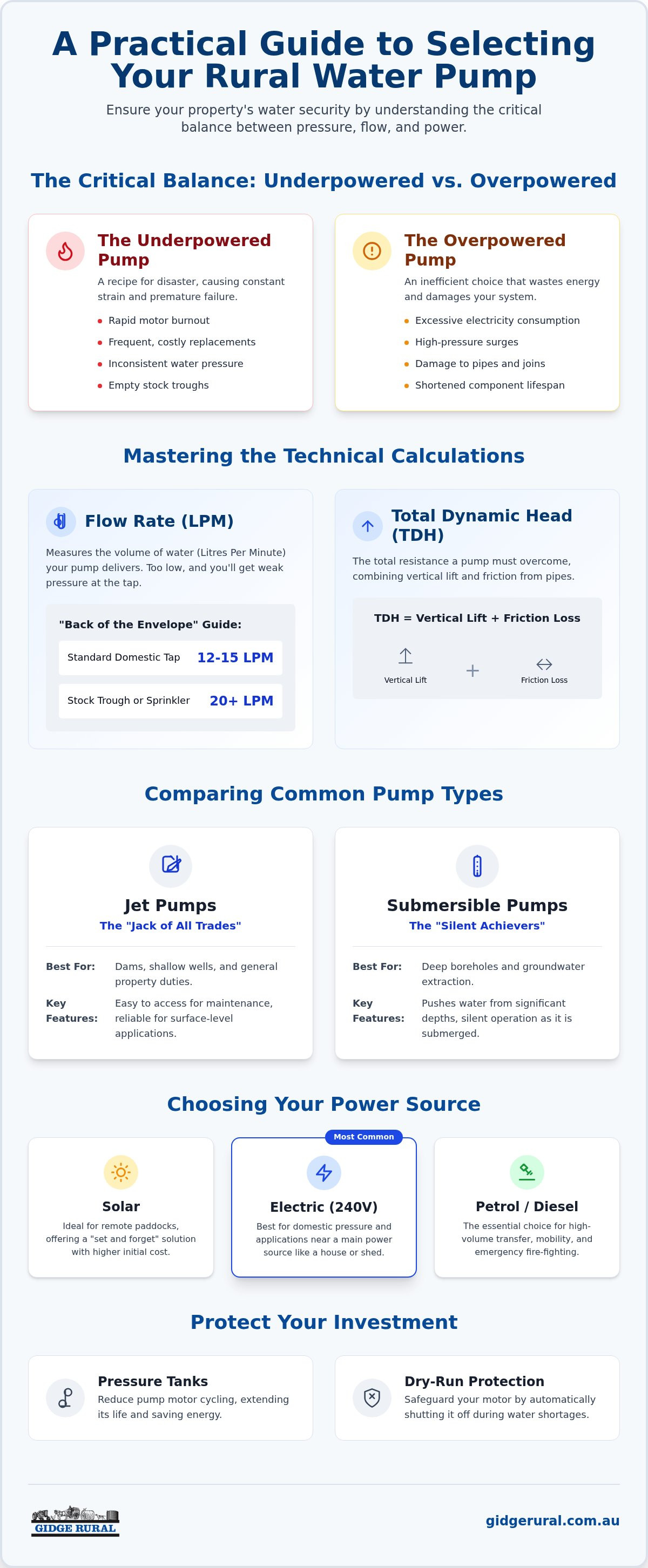
Selecting an underpowered pump is a recipe for disaster. When a motor is too small for the required head pressure, it runs constantly to keep up with demand. This leads to rapid motor burnout and frequent, costly replacements. It's an expensive cycle that leaves your water security in doubt and your troughs empty.
Conversely, an overpowered rural water pump is equally problematic. It draws excessive electricity, driving up your quarterly power bills unnecessarily. High-pressure surges can also blow out pipe joins or damage your reticulation equipment. Getting the balance right ensures your system remains energy-efficient and your components last their full operational life. Reliable water pressure at the house shouldn't come at the cost of your plumbing's integrity.
Understanding the Technicals: Flow Rate, Head Pressure, and Power
Moving water across an Australian property requires more than just a motor; it requires precise maths. To choose the correct rural water pump, you first need to understand Flow Rate. This is measured in Litres Per Minute (LPM) and describes the volume of water delivered over a set period. If your pump's LPM is too low, you'll face frustratingly weak pressure when multiple taps are open at once.
Next, consider Total Dynamic Head (TDH). This is the sum of vertical lift, which is the height from the water source to the highest point, plus the friction loss caused by the water moving through your pipes. Head Pressure is the resistance a pump must overcome to move water to its destination. Before you start browsing, map out your property's elevation to ensure you don't buy a unit that simply cannot push water uphill.
Calculating Your Requirements: The "Back of the Envelope" Guide
Use this simple checklist to estimate your needs:
- Count the number of taps and troughs likely to be used simultaneously.
- Assign 12 to 15 LPM per standard domestic tap.
- Add 20 LPM for stock troughs or large garden sprinklers.
Be mindful of your pipe diameter. A skinny pipe will choke a powerful pump, creating unnecessary friction and reducing your actual flow at the outlet. Matching your pipework to your pump's output is critical for long-term efficiency.
Solar vs. Electric vs. Petrol: Which Power Source Wins?
Choosing a power source depends on your location and specific needs. Solar Pumping involves a higher initial cost but offers a "set and forget" solution for remote paddocks. Electric (240V) models are best for domestic pressure and applications near the main meter box. For high-volume transfer and emergency fire-fighting, petrol or diesel units remain the essential choice. If you're unsure which specs fit your layout, the team at Gidge Rural can help you calculate the perfect match.
Comparing Pump Types: From Boreholes to Fire-Fighting Units
Selecting the right rural water pump depends entirely on your water source and intended use. Jet pumps are the "jack of all trades" for surface-level applications. These units are reliable for drawing from shallow wells or dams where the suction lift is relatively low. They are easy to access for maintenance and provide a sturdy, no-nonsense solution for general property duties.
Submersible bore pumps are the "silent achievers" of groundwater extraction. These units are lowered directly into the borehole, pushing water up from significant depths. Because they are submerged, they stay cool and operate with minimal noise. For those managing extensive drip irrigation supplies, multistage pumps are the superior choice. They use multiple impellers to generate the consistent high pressure required for complex watering networks.
If you need to move large volumes of water between tanks without requiring high pressure, centrifugal pumps are the most efficient option. They excel at rapid transfer, making them perfect for managing storage levels across a large site. Each type serves a specific purpose, so matching the rural water pump to the task is essential for operational longevity.
Fire-Fighting Pumps: A Non-Negotiable Rural Essential
A dedicated petrol-powered fire pump is a life-saving investment for every Australian property. During a bushfire, the main power grid is often the first thing to fail, rendering electric pumps useless. A petrol or diesel unit ensures you maintain water flow when it's needed most. These pumps feature a "self-priming" design, allowing them to draw water from dams or pools instantly without the need for manual priming.
This rapid-response capability is critical in emergency situations where every second matters. We stock reliable equipment from trusted brands like Davey and Onga to give you much-needed peace of mind. You can browse our professional range of pumps and fire equipment to ensure your property is fully prepared for the summer season.
Essential Accessories and Maintenance for Long-Term Reliability
Investing in a rural water pump is only half the battle. Long-term reliability depends on the accessories that protect your motor. Pressure tanks are vital for reducing "cycling," which is the constant starting and stopping that wears out electrical components. A tank acts as a buffer, storing pressurised water so the pump doesn't kick in every time a tap is opened. Dry-run protection is also the cheapest insurance for an expensive motor. It automatically shuts the system down if the water source fails, preventing internal components from overheating.
Filtration is another critical factor for longevity. Grit and sand act like sandpaper on pump impellers, quickly scouring the surface and dropping your flow rate. Establish a seasonal maintenance routine to prevent these issues. Check your seals for leaks, clear debris from intake screens, and always test-run your petrol fire pumps well before the bushfire season begins. Regular checks ensure your equipment remains ready when you need it most; for expert help with your home's infrastructure, you can visit GA PERRY.
Remote Monitoring: Smart Water Management
Smart water management has modernised property maintenance. Remote tank and trough sensors save you hours of "checking water" in the ute each week. These sensors provide real-time data on your storage levels. A smart controller can notify your smartphone of a pump failure or a sudden drop in pressure. It's a proactive way to ensure your stock never goes thirsty while you're busy elsewhere on the farm. This technology turns a reactive task into an efficient, automated process.
Quality Fittings and Plumbing
Your pump is only as good as the plumbing connecting it. Use high-quality poly fittings to prevent air leaks, particularly on the suction side. Even a tiny leak can cause the system to lose prime, leading to air locks and potential motor damage. Ready to secure your property’s water? Explore our range of rural water pumps today to find a solution that's built for the long haul.
Secure Your Property's Water Future Today
Choosing the right rural water pump is about more than just moving liquid from A to B; it's an investment in your property's long-term security and operational efficiency. We've explored how precise calculations of flow and head pressure prevent motor burnout and save on energy costs. Whether you're installing a silent submersible or a petrol fire unit, matching the technology to your specific source is the only way to ensure reliability during a harsh Australian summer.
Remember that accessories like pressure tanks and dry-run protection are essential for extending your system's life. Regular maintenance and smart monitoring further safeguard your stock and household supplies. Gidge Rural is a proudly Australian-owned and operated specialist. We provide expert advice for rural property owners and stock industry-leading brands like Davey and Onga. Shop the full range of reliable rural water pumps at Gidge Rural to find your perfect match. You don't have to navigate these technical decisions alone. We're here to help you build a water system that stands the test of time.
Frequently Asked Questions
What is the difference between a shallow well and a deep well pump?
Shallow well pumps are designed for water sources less than 8 metres deep, such as dams or surface tanks. They use suction to pull water up. Deep well pumps, usually submersibles, are required for depths exceeding 8 metres. They are lowered into a borehole and push water to the surface. Choosing the wrong type for your source will result in zero flow and potential motor damage.
How much flow (LPM) do I need for a standard house and garden?
A standard Australian home and garden typically requires between 30 and 50 Litres Per Minute (LPM). You should allow 12 to 15 LPM for each domestic tap and roughly 20 LPM for a garden sprinkler. If you plan to run the shower while the reticulation is on, ensure your rural water pump is rated for the combined total to avoid a frustrating drop in pressure at the outlet.
Can I run a rural water pump entirely on solar power?
Yes, you can run a rural water pump entirely on solar power, which is ideal for remote paddocks without grid access. Modern DC solar pumps are highly efficient and can be paired with batteries for overnight use or a pump-to-tank setup. This allows you to move water during daylight hours and gravity-feed your troughs or house during the night, effectively eliminating your ongoing quarterly electricity costs.
What happens if my water pump runs dry?
Running a pump dry causes rapid overheating because the water usually acts as a coolant and lubricant for the internal seals. Without liquid, the friction melts the mechanical seals and can lead to a complete motor seizure. Installing a dry-run protection sensor is a small investment that prevents this catastrophe by automatically cutting power when the water source is exhausted or the prime is lost.
How do I protect my pump from the Australian summer heat?
Protect your equipment by installing it in a well-ventilated pump house or under a purpose-built cover to block direct UV rays. Australian summers can push ambient temperatures above 40 degrees, causing motors to trip their thermal overload switch. Ensure there is plenty of airflow around the cooling fins and avoid enclosing the unit in a tight, uninsulated box that traps heat and leads to premature component failure.


