

How many times have you had to hop out of the ute and heave a heavy steel gate upward just to clear a patch of gravel and latch it shut? Dealing with farm gates Perth Hills properties require often feels like a losing battle against gravity and the local terrain. If you're tired of sagging mesh and hinges that snap the moment a bull puts his weight on them, you aren't alone. Most rural owners expect their boundaries to be set-and-forget, yet the unique slopes of the Darling Scarp quickly turn a standard entrance into a maintenance nightmare.
We understand that a gate is more than just a gap-filler; it's a vital piece of farm infrastructure. This article will help you master the art of selecting, hanging, and maintaining entrances that withstand the toughest Australian conditions. You'll learn how to choose hardware that lasts over 20 years and discover the secrets to a professional, sag-free installation on hilly ground. From galvanised steel options to high-tensile mesh, we're breaking down the components you need for a secure and easy-to-operate paddock.
Key Takeaways
- Learn how to calculate the correct 'rise and run' to prevent your gate from dragging on the uneven slopes of the Darling Scarp.
- Discover why galvanised steel remains the gold standard for rust resistance and long-term durability in Western Australian conditions.
- Identify the right gudgeons and strap hinges to support the weight of heavy-duty farm gates Perth Hills properties require for livestock security.
- Master the 'stay' system to provide the diagonal bracing your gate posts need to prevent leaning and sagging over time.
- Plan your paddock boundaries with the correct clearance widths to ensure hay trucks and wide farm machinery can pass through without a hitch.
Selecting Farm Gates for Hilly and Sloping Terrain
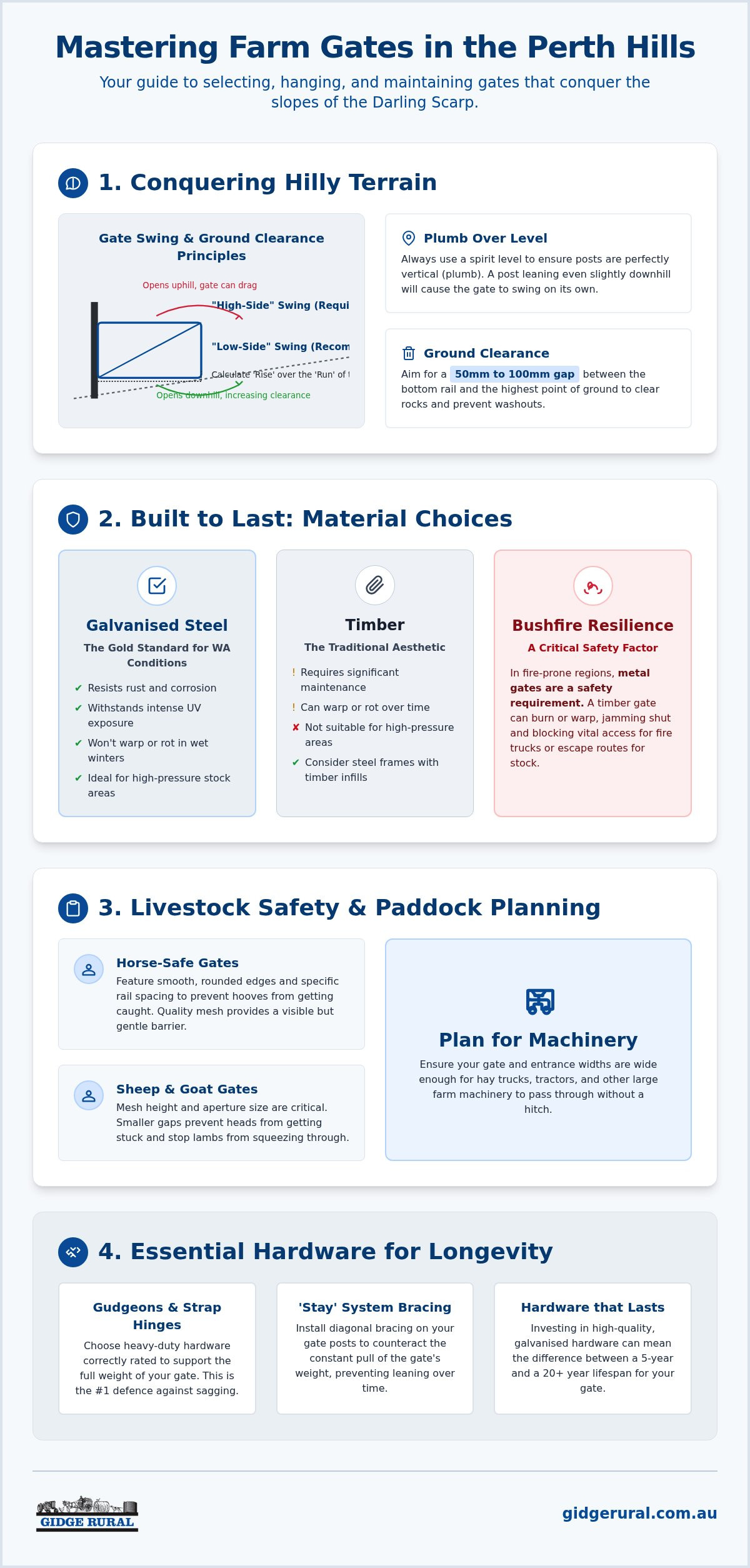
Gravity is the primary challenge when installing farm gates Perth Hills properties require. On the steep gradients of the Darling Scarp, a standard gate can easily bottom out or "ghost swing" if the physics of the slope aren't respected. You must calculate the 'rise and run' before you set your posts. If the ground rises 150mm over the length of your gate, your hinge height must account for this to prevent the frame from dragging in the dirt. Proper Agricultural fencing relies on this foundational planning to ensure long term functionality.
The direction of the swing is your next big decision. Where possible, always opt for a 'Low-Side' swing. This means the gate opens toward the downhill side of the slope, which naturally increases ground clearance as the gate rotates. If your paddock layout forces a 'High-Side' swing, you will need to use offset hinges or rising gudgeons. These specialised fittings lift the gate as it opens, clearing the rising ground without requiring you to excavate a massive arc in your driveway.
Ground Clearance and Gradient Planning
Aim for a consistent gap of 50mm to 100mm between the bottom rail and the highest point of the paddock surface. This height is enough to contain most livestock while allowing the gate to clear small rocks or tufts of winter grass. Be mindful of drainage. Hillsides naturally funnel rainwater, and a gate line can act as a dam. Ensure the area under the gate is slightly recessed or reinforced with crushed rock to prevent washouts that create gaps for sheep or dogs to crawl under. If your dog does manage to escape through an unexpected gap, having a durable tag from Pet ID Tags Australia ensures they can be quickly identified and returned home.
Visual Alignment vs. Level Hanging
Your eyes might tell you to hang the gate so it looks level with the horizon, but this is a mistake on hilly terrain. Always prioritise 'plumb' over 'level'. Use a spirit level to ensure your gate posts are perfectly vertical on all sides. If a post leans even a few millimetres downhill, the weight of the gate will cause it to swing open or shut violently. A plumb post keeps the gate stationary, ensuring it stays exactly where you leave it while you're moving stock or driving the ute through.
Material Choices for Australian Rural Conditions
Selecting the right material for farm gates Perth Hills owners install is a balance between longevity and function. Galvanised steel remains the industry benchmark for Western Australian conditions. Hot-dip galvanising provides a thick protective layer that resists rust and withstands the intense UV exposure common in the Darling Scarp. Unlike timber, steel won't warp or rot during a wet winter, making it a reliable choice for long term paddock security.
While timber rails offer a traditional rural aesthetic, they usually require significantly more maintenance. If you prefer the look of wood, consider using steel frames with timber infills to get the best of both worlds. For high pressure areas containing cattle, heavy duty I-beam or thick walled rail gates are essential. These structures provide the rigidity needed to withstand the weight of a leaning bull without buckling. If you're looking for durable components, browsing our range of fencing supplies is a great place to start.
- Mesh-Infill Gates: These are perfect for keeping smaller livestock, pets, or unwanted wildlife from passing through the boundary.
- Lightweight Mesh: Ideal for internal paddock divisions where pressure is low.
- Heavy Gauge Steel: Necessary for perimeter entrances and main race gates.
Bushfire Resilience and Gate Materials
In fire prone regions, metal gates are a safety requirement rather than a preference. During an emergency, a timber gate can burn or warp, potentially jamming shut and blocking vital access for fire trucks or escape routes for stock. Metal gates remain functional even under extreme heat. It is a good idea to integrate your gate selection with a comprehensive bushfire preparation checklist for properties to ensure your entrances are emergency ready.
Livestock-Specific Gate Designs
Different animals require different gate configurations. Horse safe gates should feature smooth, rounded edges and specific rail spacing to prevent hooves from getting caught. Using high quality mesh, such as Duncan Equine options, provides a visible barrier that is gentle on coats and skin. For sheep and goats, the height and gauge of the mesh are the most important factors. Smaller apertures prevent heads from getting stuck and stop kids or lambs from squeezing through the gaps.
Essential Hardware: Hinges, Latches, and Post Bracing
The longevity of farm gates Perth Hills owners install depends entirely on the hardware supporting them. A heavy five-metre gate exerts massive leverage on the strainer post. If you use standard 16mm gudgeons for a heavy-duty cattle gate, the steel will eventually shear or bend under the stress. Always match the gudgeon diameter to the gate weight. For most heavy rural gates, 20mm galvanised gudgeons are the minimum requirement for a 20 year lifespan.
Adjustable hinges are a lifesaver for properties on shifting soil. These allow you to realign the gate with a simple turn of a nut, correcting for any seasonal ground movement without needing to pull the post out. For security, choose your latch based on the paddock's use. Slam latches are excellent for high-traffic areas or cattle races where you need to close the gate quickly from the ute. Chain latches remain the most reliable choice for uneven ground, as they provide enough "play" to keep the gate secure even if the posts shift slightly over time.
- Gudgeons: Choose bolt-through options for timber posts and weld-on versions for steel.
- Strap Hinges: Ensure the strap length covers at least one-third of the gate's top rail for maximum support.
- Diagonal Stays: Every gate post requires a diagonal brace to transfer the weight of the gate into the ground.
Hanging Your Gate for Longevity
When working with timber posts, always drill through the centre rather than using lag screws which can pull out over time. If you're using steel pickets, welding the hinges provides the most rigid connection. Always apply the 'Three-Finger' rule during installation. This involves leaving a gap approximately the width of three fingers between the gate and the latch post. This clearance allows the gate to function properly even when the ground expands in winter or contracts during a dry Perth summer.
Bracing the Strainer Post
The gate post must be the strongest point in your fencing supplies setup. In the rocky or sandy soils of the Hills, simply digging a hole isn't enough. You should concrete the post and 'key' it by placing large rocks or cross-blocks at the base of the hole before pouring. This prevents the post from rotating or pulling toward the gate under tension. If you're ready to start your project, you can find all the necessary high-quality gate hardware at Gidge Rural.
Integration and Smart Paddock Planning
Smart paddock planning ensures your gates work with your daily routine rather than against it. When installing farm gates Perth Hills owners must consider how both livestock and vehicles move through the property. Positioning a gate in the corner of a paddock is far more effective than placing it in the middle of a fence line. Animals naturally follow the boundary when being moved, and a corner gate makes "drafting" or directing stock into a race much simpler and less stressful for the handler.
Width requirements are another critical factor. A standard 3.6-metre gate is sufficient for most utes and small tractors. However, if your property requires hay deliveries or the movement of wide seeding equipment, you will need a span of at least 4.2 to 4.8 metres. For these wider openings, double gates are often the most practical choice. If you're concerned about the centre join sagging over time, installing a 'bow' or overhead support frame provides the structural integrity needed for extra-wide spans.
Solar automation is a common upgrade for main property entrances in the Hills. To ensure reliability, position your panels for maximum North-facing UV exposure. The dense tree canopy in parts of the Darling Scarp can significantly reduce charging efficiency. It's best to clear any overhanging branches that might cast shadows during the peak daylight hours to keep your battery topped up and the gate functioning smoothly. For property owners researching broader energy solutions, the Sunsynk 8KVA Hubble AM2 combo kit South Africa serves as a prime example of the high-end hardware required for reliable off-grid power.
Vehicle Access and Turning Circles
Safety starts at the property boundary. Set-back gates, which are recessed 15 to 20 metres from the road edge, allow you to pull your ute and trailer completely off the bitumen before stopping to unlatch. This is a vital safety feature for properties located on busy rural roads. Ensure your turning circles are wide enough for emergency services. A standard fire truck requires a much larger radius than a family car, so plan your gateway to allow for easy access during a crisis.
Ongoing Maintenance for Rural Gates
The Australian climate is notoriously harsh on moving parts. Lubricate your hinges every six months with a heavy-duty grease to prevent metal fatigue and that familiar rural 'squeal'. After the first heavy winter rains or a particularly dry summer, check your strainer posts for tilt. The reactive clay and gravel soils in the Perth Hills can cause even the best-set posts to shift. A quick adjustment of your hinges now prevents a major repair job later. If you need replacement parts or expert advice, our team at Gidge Rural stocks a full range of fencing supplies to keep your property secure.
Build a Gateway That Stands the Test of Time
Selecting the right farm gates Perth Hills properties require means looking beyond the price tag to the physics of your terrain. You've seen how calculating the rise and run of a slope and choosing hot-dip galvanised steel are essential steps for long-term durability. By matching your gate weight to high-quality gudgeons and ensuring your strainer posts are keyed and braced, you prevent the common headache of sagging and dragging for years to come.
At Gidge Rural, we provide expert local advice for Gidgegannup and the surrounding regions. We stock a full range of gudgeons, latches, and diagonal bracing to ensure your DIY project is a success from day one. Our galvanised steel products are built for the harshest Aussie conditions, giving you peace of mind that your livestock are secure and your entrances are easy to operate. Don't settle for flimsy mesh when you can install a professional-grade boundary that adds real value to your land.
Ready to transform your paddock boundaries? Explore our range of heavy-duty farm gates and hardware today. With the right materials and a bit of planning, your new gate will be a reliable asset for decades to come.
Frequently Asked Questions
How wide should a standard farm gate be for vehicle access?
A 3.6-metre (12-foot) gate is the standard for utes and small tractors on most rural properties. If you expect deliveries from hay trucks or need to move wide seeding machinery, you should opt for a width of at least 4.2 to 4.8 metres. When planning farm gates Perth Hills properties often require for road frontage, a wider opening provides a safer turning circle for larger vehicles entering from narrow rural roads.
What is the best way to stop a farm gate from sagging over time?
Installing a robust diagonal stay on your strainer post is the most effective way to prevent sagging. This brace transfers the gate's weight into the ground rather than pulling the post over. Using adjustable hinges also allows you to correct minor seasonal movements with a spanner, ensuring the gate latches perfectly year-round without needing to re-hang the entire frame or dig new post holes.
Should I use timber or steel posts for my property entrance?
Steel posts are generally superior for durability and bushfire resilience in Western Australian conditions. Galvanised or black steel posts won't rot, warp, or burn, making them a reliable solution for rural boundaries. While timber posts offer a traditional look, they require more frequent maintenance and are susceptible to termite damage and ground moisture in the damp winter months.
Can I automate an existing manual farm gate on a solar kit?
You can certainly retrofit most manual gates with a solar automation kit provided the gate is structurally sound and swings freely. The key is ensuring the gate is perfectly plumb and balanced so the motor isn't fighting gravity. For farm gates Perth Hills owners want to automate, check that the frame doesn't drag on the ground at any point in its arc before installing the drive arm.
What type of latch is most secure for keeping horses in a paddock?
A heavy-duty slam latch or a horse-safe sliding bolt is the most secure option for equine paddocks. These designs lack sharp protruding parts that could cause injury and are difficult for a clever horse to nudge open. Chain latches are also highly secure if used with a proper snap hook, as they allow for some post movement without compromising the lock during dry summer spells.


