

A fixed worming calendar isn’t automatically the safest choice. Australian guidance favours a plan based on parasite risk and faecal egg count results, rather than treating every horse at the same interval. If advice conflicts or a product label doesn’t make its parasite coverage clear, choosing a horse wormer can feel uncertain. The decision calls for more than picking a product off the shelf.
This guide explains how your horse’s age, health and exposure can shape treatment decisions, and what active ingredients and treatment forms mean in practice. You’ll learn why routine worming and rotating products with every dose are no longer recommended, how faecal egg counts can inform a plan, and how to give and record treatment safely. The aim is a practical approach that reflects your horse’s individual risk, with veterinary guidance where needed.
Key Takeaways
- Consider your horse’s age, grazing and contact with other horses when assessing parasite risk.
- Compare horse wormer ingredients and forms against the parasites being targeted and current veterinary guidance.
- Build a plan around your horse and its conditions, rather than relying on one schedule for all of Australia.
- Before treating, confirm the horse, follow the product label and keep a clear record of the treatment.
Why choosing a horse wormer starts with your horse’s parasite risk
A worming treatment should match the parasites relevant to the horse, rather than follow a one-size-fits-all routine. Age, grazing exposure, pasture management and contact with other horses all contribute to the risk picture. Conditions vary across Australia, so the same calendar may not suit every horse or property. A faecal egg count can help assess parasite shedding, while a veterinarian can interpret results alongside the horse’s history and advise on an appropriate plan.
Ingredient names alone don’t show whether a product suits a particular horse or treatment goal. For example, fenbendazole, a common horse wormer ingredient, is one name you may encounter. Check the product label for its stated parasite coverage and follow veterinary guidance when selecting a treatment.
A calendar-based routine treats by date; a monitored plan bases decisions on the horse’s risk and relevant test results.
What factors can change a horse’s worming needs?
Young horses and adults may face different parasite concerns. Grazing access, pasture use and manure management can affect exposure. Herd contact matters too: a horse joining a property or sharing grazing has a different history from one kept in a stable group. These details help build a risk picture, but none can diagnose an infestation or determine treatment on its own. When reviewing risk, note changes in grazing arrangements, group membership and management rather than relying on memory.
Why visible signs are not a worming diagnosis
Weight loss, a rough coat, changes in appetite or loose manure can have many causes. Their presence doesn’t prove a horse has worms, and a horse may carry parasites without obvious signs. Avoid choosing a treatment based on appearance alone. If you notice a change in your horse’s health, speak with a veterinarian, who can assess the signs and advise on suitable testing or care.
How to compare horse wormer ingredients and treatment forms
First identify the treatment goal and check which parasites the product targets. Then consider whether you can administer that form as directed. These are separate decisions: the treatment form affects how you give a product, while its label explains which parasites it targets. No format is automatically right for every horse.
What to check when comparing active ingredients
Read the current Australian product label for the active ingredient, stated parasite coverage, directions and warnings. Products can target different parasites, so don’t assume a wormer covers every type. Compare the label with the treatment goal, and use veterinary advice to interpret test results or decide between options. If you’re unsure whether an ingredient is suitable for your horse, seek veterinary guidance before treating.
Paste, gel or granules: which form may suit your horse?
Consider your horse’s temperament and which form you can administer reliably. Check the exact method and directions on the product label, as instructions can differ between products. For feed-based forms, consider whether the horse is likely to eat the full portion, if the label directs you to mix the product with feed.
| Form | Administration considerations |
|---|---|
| Paste | Typically delivered from a dosing syringe. Consider whether your horse accepts oral handling. |
| Gel | May also use a syringe-style applicator. Follow the label’s instructions for delivery. |
| Granules | Check whether the label directs mixing with feed, and whether your horse will eat the full portion. |
| Pellets | Check how the product is to be offered and make sure the horse receives it as directed. |
Don’t switch formats or estimate a dose based on another product. Use the directions for the specific treatment, including any weight-based instructions. Gidge Rural stocks animal health supplies through its shop and online store. Explore its animal health supplies when you’re organising practical care products.
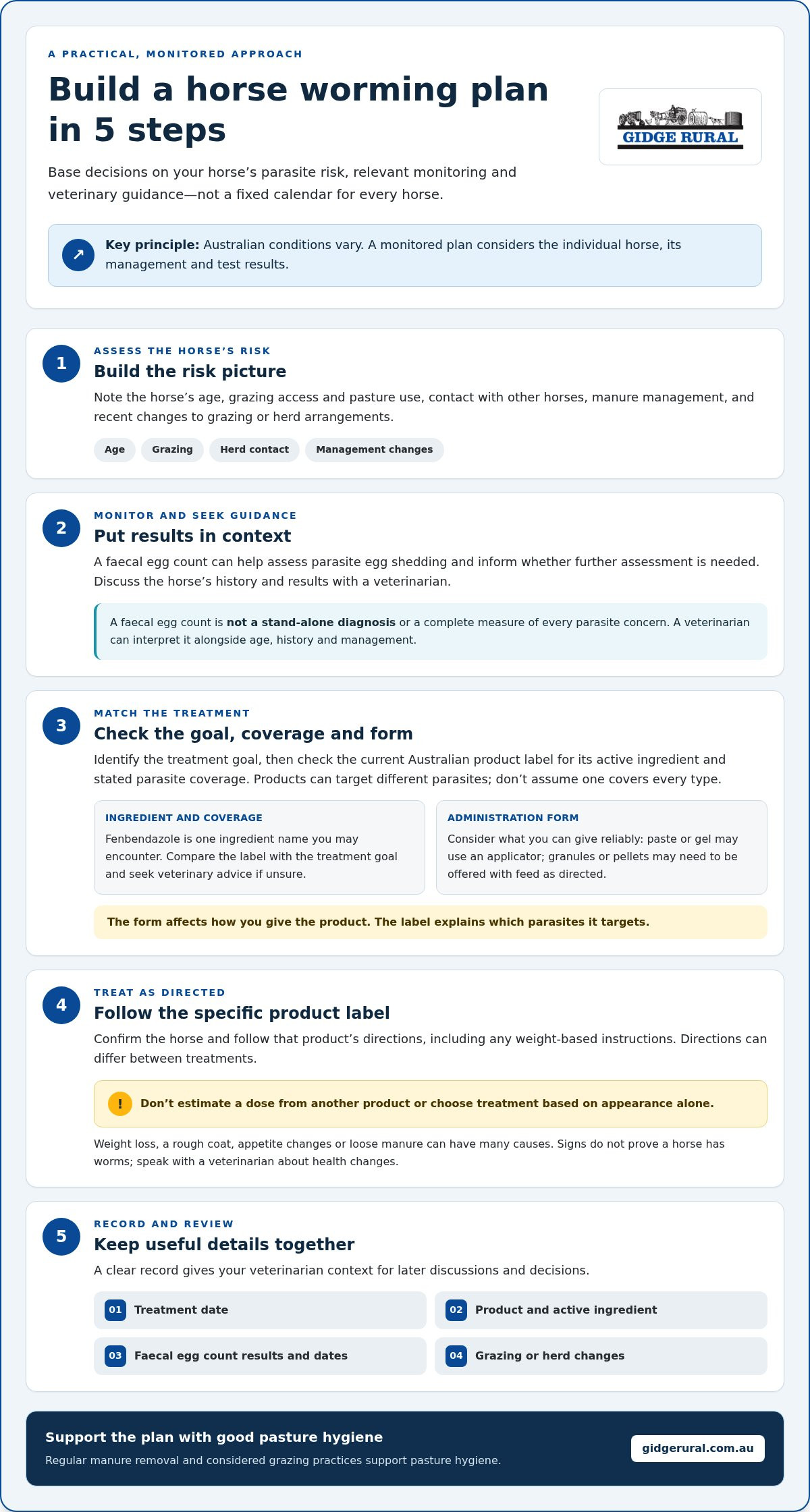
How to build a practical horse worming plan for Australian conditions
Australian climates and grazing conditions vary, so one national timetable won’t suit every horse. Build the plan around the horse’s circumstances, monitoring and veterinary advice, rather than relying on a fixed seasonal interval. Keep the horse’s age, grazing arrangements, contact with other horses and recent management changes together when reviewing the plan.
- Assess risk. Note the horse’s age, grazing arrangements, herd contact and any recent management changes.
- Seek guidance. Discuss the horse’s history and monitoring results with a veterinarian before changing its routine.
- Select treatment. Choose a treatment that fits the goal and the horse’s needs, guided by veterinary advice and the product label.
- Follow the label. Check the directions for the specific product and horse. Instructions may differ between treatments.
- Record results. Log treatment and monitoring details to inform later discussions and decisions.
Use monitoring to inform treatment decisions
A faecal egg count can help monitor parasite egg shedding and inform whether further assessment is needed. It isn’t a stand-alone diagnosis or a complete measure of every parasite concern. A veterinarian can interpret the result alongside the horse’s age, history and management, then advise on a suitable plan. Keep results with the horse’s records so they can be considered over time. When comparing results, include the date and any recent treatment details to give the veterinarian useful context.
Keep records and manage pasture hygiene
Record the treatment date, product and active ingredient, along with relevant test results and changes in grazing or herd contact. Regular manure removal and considered grazing practices support pasture hygiene. These practical steps sit alongside a broader property-care routine, which can include the animal health supplies covered in Gidge Rural’s guide. They don’t replace veterinary advice or a risk-based plan. Browse Gidge Rural’s range of rural animal health supplies in-store or online.
How to use horse wormer safely and choose your next step
Good administration starts before you open the product. Set aside a quiet moment, have the label to hand and confirm you’re treating the intended horse. If the horse becomes distressed or safe handling is difficult, pause rather than forcing the treatment. Get veterinary guidance on how to proceed.
- Confirm the horse and check the product is the treatment selected for it.
- Read the label, including preparation, directions, storage instructions and warnings.
- Follow the stated method and any weight-based dosing directions. Don’t guess a dose.
What to check before administering a treatment
Some labels base directions on the horse’s weight, so an accurate weight estimate matters. Use a suitable weighing method where available, and seek veterinary advice if you’re unsure how to estimate weight or interpret the label. Don’t assume directions for one product apply to another. Check suitability and timing with a veterinarian if your horse has health concerns or the right treatment is unclear.
Keep handling calm and patient. Prepare the product as directed, approach the horse steadily and use the administration method stated on the label. If the horse resists strongly, stop and reassess the situation with professional guidance. Forcing treatment can put both horse and handler at risk.
Make worming records useful for future decisions
After treatment, record the product name and active ingredient, the date given and any relevant monitoring information. Note whether administration went as planned and keep the label details with the record. These notes help a veterinarian review the horse’s history and discuss next steps. Don’t use them to set an automatic repeat date, since the plan should reflect current risk and advice.
Gidge Rural stocks practical rural animal health supplies in-store and online. Use veterinary guidance to choose treatment, then follow its label and keep clear records to support careful administration.
Keep your horse’s care plan ready to adapt
Make your next step a review point, not an automatic treatment date. If your horse’s health, grazing arrangements or herd situation changes, note what has shifted and discuss whether the plan still fits. Keeping that conversation grounded in the horse’s current circumstances can help you avoid treating by habit. A horse wormer should remain part of a considered approach, with veterinary advice guiding decisions where you’re unsure.
Keep the product label and treatment notes accessible so you can refer to them when reviewing the plan. Consistent record-keeping makes future decisions easier to discuss and act on.
For rural animal health products, browse Gidge Rural’s animal health supplies in-store or online, and choose products with your horse’s care plan in mind.
Frequently Asked Questions
How often should you give a horse wormer?
There’s no single interval that suits every horse; timing should follow the individual plan, monitoring and product label. Before the next dose, check the treatment record and any recent faecal egg count rather than repeating a date copied from another horse. If a dose was missed, circumstances have changed or you’re unsure whether to treat, ask a veterinarian what to do rather than doubling up or restarting a routine.
Can you use the same horse wormer for every horse?
Not necessarily. A horse wormer that fits one animal may not suit another, even in the same paddock. A younger horse, one with a different health history or one recently introduced to the group may need individual assessment. Keep product and treatment records by horse, not just by herd, and get veterinary advice before treating several animals under one plan.
What does a faecal egg count tell you about a horse?
A faecal egg count estimates the number of parasite eggs in a manure sample, offering one piece of information for monitoring discussions. It reflects what is shed in that sample, not a full inventory of parasites in the horse, so a low or negative result doesn’t rule out every concern. Tell the veterinarian about recent treatment, age, grazing and health changes to help put the result in context.
How do you worm a horse that resists treatment?
Use calm handling and follow the product’s directions; don’t force administration if the horse resists. Choose a quiet, secure place and have the labelled product ready before starting. If the horse repeatedly moves away or becomes unsafe to handle, stop. A veterinarian can suggest an approach for future treatment. Don’t mix the dose into feed unless the label allows it.
Do horses always show signs when they have worms?
No. Some horses may show no obvious signs, while changes such as weight loss or altered manure can have causes other than worms. Don’t use appearance alone to select a treatment or rule out a parasite concern. Note when a change started and any shifts in appetite or management, then share those details with your veterinarian, especially if your horse seems unwell or its condition is worsening.


