

A cheap fence is often the most expensive mistake you'll ever make on your land. It's a common frustration for Australian property owners to invest weeks of hard work only to have wire sag or posts fail within just a few seasons. Choosing the right rural fencing supplies is about more than just finding the lowest price; it's about matching your materials to your stock pressure and the harsh local environment. You want a boundary that keeps your cattle in and the neighbours' dogs out without needing a constant weekend repair schedule.
We understand that the terminology can be a headache, especially with updated 2026 standards like AS 4100 changing how we look at steel structures. This article provides a no-nonsense checklist to help you organise your next project with total confidence. You'll learn exactly how to calculate quantities, select between high-tensile and soft wire, and pick the right post spacing for your specific livestock. From heavy-duty gates to the latest in solar-powered energisers, here is everything you need to procure for a professional-grade finish.
Key Takeaways
- Match your wire gauge and post spacing to specific livestock pressure to ensure your boundary remains secure and effective for decades.
- Discover how to select the right rural fencing supplies for your terrain, including a comparison between high-tensile wire and soft wire for different applications.
- Protect your property against the elements by choosing fire-resistant steel posts and heavy galvanised coatings that prevent premature rusting in humid or coastal zones.
- Learn the professional method for calculating exact material quantities, including wire runs and gate subtractions, to streamline your procurement and reduce waste.
Planning Your Paddock: The Essential Needs Assessment Checklist
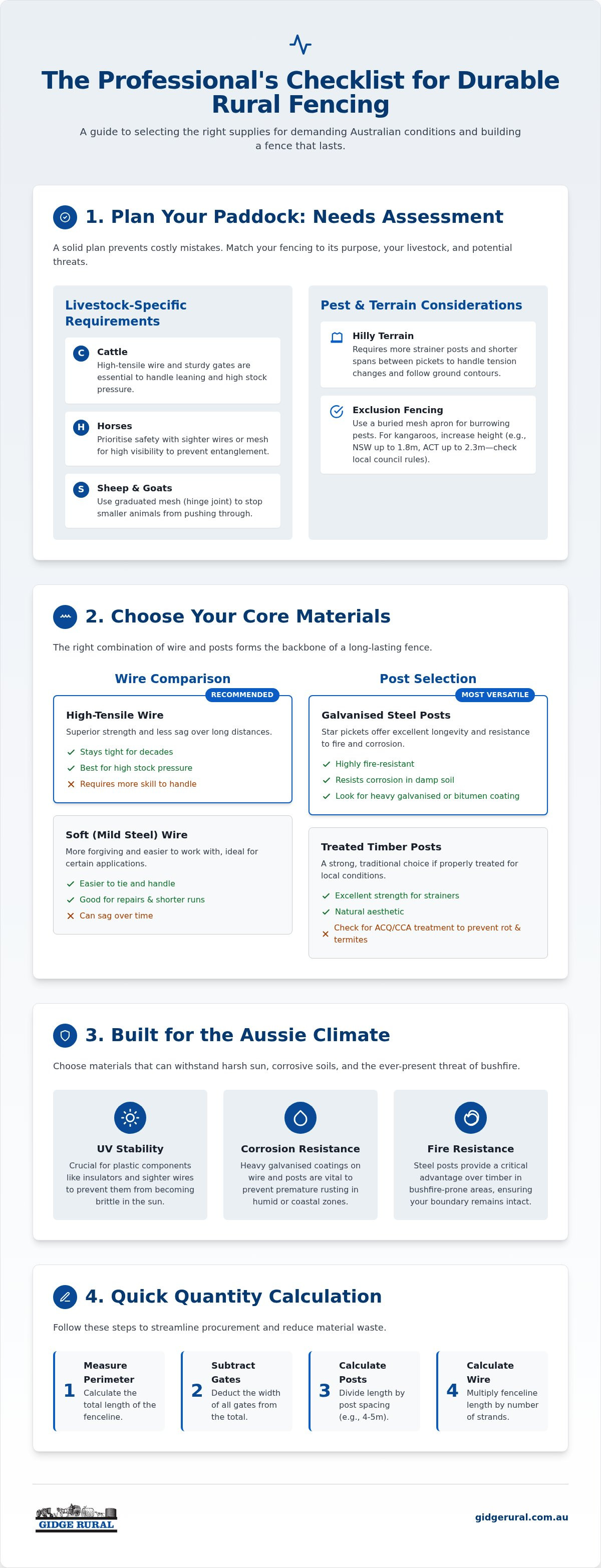
Building a fence starts with a clear plan. You need to identify if you're securing a boundary or creating internal cell grazing. High-pressure areas like stockyards require different rural fencing supplies than a quiet back paddock. For a broad agricultural fencing overview, the primary goal is always containment and protection. Map your terrain before buying. Hilly sections mean you'll need more strainer posts to handle the tension changes on slopes. Shorter spans between pickets also help the wire follow the ground contour.
To better understand this concept, watch this helpful video:
Livestock-Specific Requirements
Cattle need high-tensile wire and sturdy farm gates to handle leaning and rubbing. For horses, safety is the priority. Use sighter wires or mesh to ensure visibility and prevent leg entanglement. Sheep and goats require graduated mesh, often called hinge joint, to stop small stock from pushing through or getting heads stuck. Matching your rural fencing supplies to the animal's behaviour saves money on repairs later.
Pest and Exclusion Logic
Exclusion fencing is a growing priority in 2026. If you're dealing with burrowing pests like rabbits or wombats, include an apron of mesh buried at the base. For kangaroo or wild dog exclusion, your fence height needs to increase significantly. Standard boundary heights vary by state. NSW allows up to 1.8 metres, while ACT allows up to 2.3 metres. Always check your local council for specific height regulations to stay compliant. Proper planning ensures your fence does its job without legal or structural failure.
Selecting Your Rural Fencing Supplies: Wire, Posts, and Hardware
Selecting the right rural fencing supplies is the difference between a fence that lasts thirty years and one that fails in five. Every component must work as a system. Start with your strainer assemblies. These are the backbone of your fence. Heavy-duty steel or large-diameter timber strainers must be deeply set to withstand the immense pressure of tensioned wire. Without a solid anchor, the rest of your materials are useless. Don't overlook the small stuff either. High-quality wire strainers and clips are essential for maintaining tension over time.
The Wire Checklist
Your wire choice depends on the stock you're containing and your budget. High-tensile wire offers superior strength and stays tight over long distances, though it requires more skill to handle. Soft wire is more forgiving and easier to tie, making it a popular choice for shorter runs or repairs. Consider these specific types for your project:
- Barbed wire: Crucial for the top line in cattle paddocks to prevent leaning and rubbing.
- Plain wire: Ideal for electric offsets or simple internal partitions where high pressure isn't an issue.
- Prefabricated mesh: The gold standard for exclusion fencing and keeping smaller livestock like sheep or goats secure.
Posts and Pickets
Choose posts based on your soil type and local environmental risks. Galvanised star pickets are versatile and resist corrosion in damp ground. Ensure they are either "black" bitumen coated or fully galvanised for maximum longevity. If you prefer timber, check for ACQ or CCA treatment levels. These chemicals are vital to prevent rot and termite damage in Australian conditions. If you're unsure which combination suits your soil, you can get expert advice on fencing gear to ensure you're making a durable investment. Matching your posts to your wire type ensures the entire structure moves and ages at the same rate.
Durability in the Australian Climate: Materials That Last
The Australian sun and soil are brutal on rural fencing supplies. You can't just pick the cheapest wire and expect it to survive a decade. You need to match your materials to your specific environmental stressors. For instance, UV stability is vital for any plastic insulators or sighter wires. If they aren't UV-rated, the harsh sun will turn them brittle and snap them within a single season. Choosing the right coating is just as critical as the steel itself.
Protection Against Corrosion
High-risk zones like coastal properties or areas with high rainfall accelerate metal fatigue. Standard galvanised wire is fine for dry inland paddocks, but it won't cut it near the ocean. Heavy galvanised coatings provide a thicker protective layer that prevents salt spray from eating the steel. Avoid "cheap" wire that often rusts through in less than five years in harsh conditions. In highly acidic or saline soils, use bitumen-coated posts. This extra barrier prevents premature rusting at the ground line where moisture and salt concentrate.
Fire and Extreme Weather Readiness
In fire-prone regions, steel posts and wire are far superior to timber. Timber posts can smoulder and fail, leaving your stock to wander onto roads during an emergency. Ensure you incorporate steel strainer systems into your bushfire preparation checklist for properties. For those in flood-prone areas, consider "sacrificial" fencing lines. These use lighter ties that allow the wire to drop under the weight of debris. This clever setup saves your expensive strainer posts from being ripped out of the ground by flood pressure. You can shop durable rural fencing supplies that are built to withstand these exact Australian conditions.
Calculating Quantities and Final Gear Checklist
Precision in the planning phase prevents expensive delays and multiple trips to the store. Before you order your rural fencing supplies, you need a firm count of every component. Start by measuring the total perimeter of your project area. Subtract the width of every gate opening to find your actual wire run. Standard post spacing for most Australian rural applications is 3 to 5 metres. Use tighter spacing for high-pressure stock like bulls or in areas with high animal traffic. Don't forget the consumables. You'll need tie wire, staples, and insulators if you're installing electric offsets. These small items are easy to overlook but essential for a professional finish.
The Procurement Shopping List
Beyond the practicalities of rural maintenance, many property owners enjoy bringing a touch of nature indoors; if you want to learn more about unique houseplants, you can visit Mygreenscape for a detailed guide on goldfish plant care.
Always add a 10% buffer to your wire and post counts. This extra margin covers wastage during the tensioning process and accounts for tricky corners or unexpected breaks. It's much cheaper to have a few spare pickets than to pay for a second delivery. When you're ready to buy, remember that bulk rural fencing supplies often require specialised transport. Long timber posts or heavy wire rolls aren't easily moved in a standard ute. Organising a flatbed delivery ensures your gear arrives safely and is dropped exactly where you need it on the property.
Essential Installation Tools
The right tools make the job safer and significantly faster. A "Chain Strainer" is the most important tool in your kit. It allows you to achieve the correct wire tension without snapping the line or risking injury. For the posts, choose a driver that matches your soil hardness. Manual drivers are fine for soft ground, but pneumatic options are a lifesaver in hard-packed earth or rocky terrain. A pair of heavy-duty pliers is also mandatory for twisting wire and pulling old staples. Having these tools ready before you start prevents the frustration of a half-finished job.
Build a Boundary That Lasts
Building a fence that lasts decades requires more than just hard work; it demands a strategic choice of materials. You now know how to assess stock pressure and select climate-resilient rural fencing supplies that withstand fire and corrosion. By planning for your specific terrain and including a 10% procurement buffer, you'll avoid the frustration of mid-project delays and future repair costs. A well-constructed boundary is an investment in your land's security and value.
Gidge Rural is here to help you get the job done right. We offer expert advice for Australian property owners and a comprehensive range of wire, posts, and gates to suit any application. Our team is available 7 days a week for all your fencing and hardware needs. Browse our full range of durable rural fencing supplies today to find high-quality gear built for local conditions. Good luck with your build; there's nothing quite like the satisfaction of a straight, sturdy fence line.
Frequently Asked Questions
What is the best type of wire for cattle fencing in Australia?
High-tensile 2.5mm wire is the industry standard for cattle because it maintains tension under heavy pressure. You should pair this with at least one line of barbed wire at the top to discourage cattle from leaning or rubbing against the fence. This combination ensures your rural fencing supplies investment lasts longer by preventing structural sagging. It's a robust solution that keeps large livestock contained while requiring minimal maintenance over the years.
How many star pickets do I need per kilometre of fencing?
You will generally need 250 star pickets per kilometre if you use the standard spacing of 4 metres. This count doesn't include your strainer assemblies, which you'll need at every corner and gate opening. If your terrain is particularly hilly or follows a winding boundary, you should reduce the spacing to 3 metres. This requires roughly 333 pickets per kilometre to ensure the wire follows the ground contour properly.
Should I use timber or steel posts for my rural property?
Steel posts are generally superior for modern Australian properties due to their fire resistance and immunity to termites. While treated timber is traditional, it remains vulnerable to ground rot and smouldering during bushfires. Steel star pickets and strainers are faster to install and offer better longevity in most soil types. They are a core part of reliable rural fencing supplies for owners who value a low-maintenance boundary that survives extreme weather.
How do I prevent my rural fence from rusting in salty soil?
Use heavy galvanised wire and bitumen-coated posts to combat corrosion in salty or acidic soils. Standard galvanisation often fails within a few years in coastal zones, but heavy-duty coatings provide a much thicker sacrificial layer of zinc. Bitumen-coated pickets are specifically designed for high-salt environments, preventing the steel from making direct contact with corrosive ground moisture. This setup ensures your fence stays structurally sound despite the harsh local conditions.
Is electric fencing better than traditional wire for horses?
Electric fencing is often safer for horses because it acts as a psychological barrier rather than a physical one. Horses have a flight response and can easily injure themselves if they become entangled in traditional plain or barbed wire. A high-visibility electric tape or sighter wire encourages them to stay clear of the boundary. This reduces the risk of nasty leg lacerations and keeps your animals secure without the danger of entanglement.


